
The Sports Coupe With Toyota Reliability And McLaren-Like Engagement
On paper, today’s Performance Cars are engineering marvels. They shatter quarter-mile times with ease, lap racetracks at speeds on par with some racecars, and use software that saves you when you mess up. Even regular cars are way faster than some sports cars from twenty years ago. But, if you speak to true driving enthusiasts, they all say the same thing; something is missing. The connection between man and machine has been systematically filtered out in favor of all-out performance. But deep in the English countryside, a British manufacturer still makes one of the most engaging sports cars on the planet, with bulletproof reliability.
Modern Sports Cars Often Sacrifice Driver Engagement For Speed

We now live in a time when numbers are everything. Car manufacturers know that 0–60 times, lap records, and peak horsepower figures always make the headlines. To make those headlines, engineers have turned to technology to overcome the laws of physics. Modern sports cars have grown significantly larger, heavier, and far more complex. To make these heavy cars blisteringly fast, carmakers replaced high-revving naturally aspirated engines with heavily turbocharged engines that deliver massive, instant torque. To put that power down safely, complex all-wheel-drive systems, electronic torque vectoring, and aggressive stability control programs take over.
Perhaps the biggest casualty in this arms race has been steering feel. Traditional hydraulic steering systems—which mechanically transmitted every ripple, bump, and change in tarmac texture directly to the driver’s palms—have been almost universally replaced by electronic power-assisted steering. While this modern steering is very accurate, it feels numb to the driver.
More Power Hasn’t Always Made Better Sports Cars

There is a distinct difference between speed and sensation. Going fast is easy when a computer is doing the heavy lifting; feeling connected while doing so is entirely different. Just look at electric cars: they are faster than a comparable gas car, but they lack sound, emotion, and any form of engagement. In essence, they’re not fun.

Many modern performance machines leave enthusiasts feeling like passengers rather than active participants. You press the pedal, the digital dash flashes, the car warps forward, and the computer manages the traction. It is insanely fast, but it requires very little skill or involvement. To make matters worse, the recent push toward hybridization has added even more weight and complexity, which are potential failure points. Rather than refining the pure, mechanical act of driving, modern performance cars have largely become rolling supercomputers. They are undeniably brilliant at going fast, but that’s not enough.
The Most Engaging Cars Aren’t The Most Reliable

If modern high-tech sports cars feel clinical, the remedy has always been to look toward purist performance cars, high-strung Italian exotics, or lightweight European sports cars. These are machines designed strictly for the thrill of driving with communicative steering, manual gearboxes, amazing chassis dynamics, and orgasmic engine notes. However, some of these pure drivers’ cars usually come with a dose of anxiety.
Historically, the most intoxicating performance cars have been notoriously fragile. Exotic Italian supercars, hand-built British lightweight specials, and high-strung German sports sedans are legendary for their high maintenance as they age. Cars like the Lotus Esprit, BMW E60 M5 V10, E92 M3, B8 Audi RS5, Maserati GranTurismo, Mazda FD RX-7 and many more are some of the most engaging cars on earth. But owning them means dealing with temperamental electronics, delicate valvetrains, fragile clutch systems, and fluid leaks.
For the average enthusiast, the dream of owning an exotic quickly turns into a nightmare when routine service easily costs five figures, or when a bad sensor grounds the car for weeks while parts are shipped from overseas. Enthusiasts have been conditioned to accept a harsh trade-off: if you want a performance car with pure driving bliss, you may have to deal with constant maintenance and questionable reliability. But there is one vehicle that has all of these attributes: a mid-engine car with Toyota-like reliability.
The Lotus Evora Feels Like A Baby McLaren

The Lotus Evora is a mid-engine, lightweight sports car with the razor-sharp handling of the very best supercars and the legendary driving engagement Lotus is known for. The Evora was built around a lightweight, extruded aluminum bonded chassis—a technique Lotus perfected to ensure immense structural rigidity without adding unnecessary weight (2,800–3,200 pounds). From a dynamic standpoint, the Evora punches far above its weight class.
Drive an Evora back-to-back with a modern McLaren, and the similarities are striking. Like McLaren’s, the Evora’s mid-engine layout gives a perfectly balanced center of gravity and eager, instantaneous turn-in. Like McLaren, Lotus does not sacrifice ride quality, so the car is quite comfortable. But the steering, in particular, is a masterclass in feel.
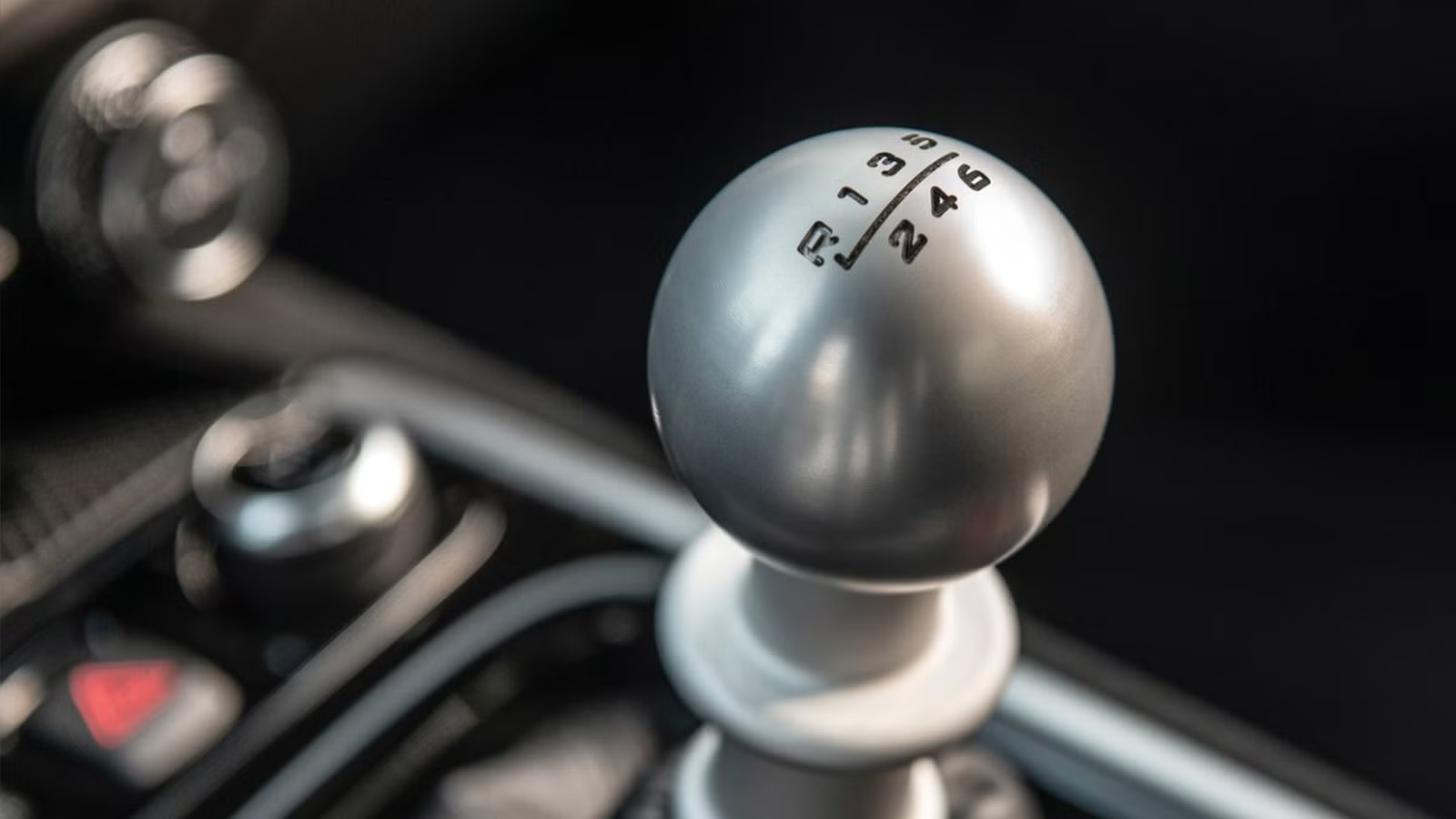
Lotus famously retained a hydraulic steering rack for the Evora’s entire production run, and it communicates with the driver in such a way modern electronic racks simply cannot replicate. Pair that with a satisfying six-speed manual transmission, and this is one of the most engaging exotic cars on the planet.
It Uses One Of Toyota’s Greatest Engines

Lotus has always used Toyota engines for its sports cars, and the Evora is no different. Under the rear deck sits Toyota’s legendary 3.5-liter 2GR-FE V6 engine. This may sound boring as versions of the 2GR-FE powered sensible family haulers like the Toyota Camry, RAV4, and Lexus RX350. But in automotive engineering, simple and mass-produced often means bulletproof. The 2GR-FE is widely regarded as one of the most reliable V6 engines ever constructed, capable of effortlessly racking up hundreds of thousands of miles with little more than routine oil changes.
However, Lotus didn’t just drop a stock Camry engine into an exotic car and call it a day. They retuned the ECU, optimized the intake and exhaust systems, and, in later variants like the Evora S, 400, and GT, bolted on a Roots-type supercharger. Early NA cars made 276 horsepower and 258 lb-ft of torque, while later supercharged cars made 345–416 hp and 295–317 lb-ft of torque. The result was an engine that screams up to its redline with a glorious, supercharged induction whine, pushing the Evora 400 and GT from 0 to 60 mph around 4 seconds, all while retaining the underpinnings of an engine built to survive decades of daily abuse.
It Isn’t The Fastest But One Of the Most Engaging Modern Cars

If you evaluate the Lotus Evora purely on a spec sheet, you might miss the point. In a straight line, a modern dual-clutch sports car or high-powered EV will out-accelerate it. But the Evora was never built to win drag races; it was built for corners and reigniting the pure joy of driving. The Lotus philosophy has always been summarized by founder Colin Chapman’s famous motto: “Simplify, then add lightness.” Weighing in at around 3,100 pounds depending on the trim, the Evora is significantly lighter than almost every modern performance car in its class.
Because it isn’t carrying excess weight, it doesn’t need rock-hard suspension or intrusive electronic aids to handle exceptionally well.
At the same time, the Evora marked a major turning point for Lotus. Older Lotus models like the Elise and Exige were notoriously compromised bare-bones track weapons with exposed aluminum floors, no sound deadening, and difficult ingress and egress. The Evora brought Lotus into the modern era. It introduced a refined leather-trimmed cabin, usable air conditioning, modern infotainment, a backup camera, and even a usable pair of small rear seats or a rear luggage shelf. It combines raw driving engagement with genuinely usable comfort.
Toyota Reliability Completely Changed The Ownership Experience
The phrase “daily-driver exotic/supercar” gets thrown around constantly, but the Lotus Evora actually lives up to the moniker. Because the heart of the car is a Toyota V6, the ownership experience is radically different from any European competitor. You don’t need a specialized exotic race shop just to perform an oil change or basic engine service. Consumable parts like spark plugs, belts, filters, and sensors are widely available, inexpensive, and accessible.
There are no engine-out service intervals for simple belt changes, no fears of catastrophic bore scoring, and no bank-breaking emergencies. You can pack a bag, hit the road on a 2,000-mile road trip, sit in stop-and-go traffic with the air conditioning blasting, and never once glance nervously at the temperature gauge. It affords the owner complete peace of mind, which is a rare luxury in the world of exotic performance cars.
The Lotus Evora Might Be The Smartest Sports Car You Can Buy

When you look at what the Lotus Evora offers, it becomes clear that it sits in an absolute sweet spot for enthusiast buyers. Finding a car that checks every major purist box is nearly impossible in today’s market, yet the Evora hits them all simultaneously: a mid-engine car with great handling, a lightweight chassis, a manual gearbox, hydraulic steering, and bulletproof reliability.
Modern Porsches have transitioned to electronic steering, mid-engine Ferraris and McLarens have completely abandoned manual gearboxes, and lightweight track cars aren’t comfortable. From a value perspective, the Evora shines bright on the used and pre-owned market. While equivalent mid-engine offerings from Germany or Italy are expensive and often have steep depreciation or crippling out-of-warranty maintenance costs, the Evora remains a financially savvy choice.
The average price for a base Evora sits at $38,000 while later 400 and GT models are $64,000 and $83,000 respectively. However, the Evora holds its value remarkably well due to its low production numbers and strong enthusiast demand, all while having maintenance costs similar to those of a Toyota Camry.
This Is A True Engaging Daily Driver Exotic

The Lotus Evora is a rare gem in an increasingly homogenized automotive landscape. It proves that you don’t need 700 hp, complex hybrid batteries, or computer-controlled all-wheel-drive systems to build a truly magical performance car. By pairing a world-class, lightweight British chassis with an unbreakable Japanese heart, Lotus created something special: a mid-engine exotic that delivers the raw steering feel, balance, and drama of a McLaren, backed by the turn-key reliability of a Toyota. For the driving purist who wants to experience genuine driver engagement without living in fear of crippling repair bills, the Lotus Evora isn’t just a great sports car—it might just be the smartest one ever built.
Sources: Lotus, Toyota, McLaren, Classic.com.

Related posts




Latest Post


No Comments