
The Used Honda Cruiser That’s A Long-Distance Hero
A capable long-distance cruiser motorcycle doesn’t necessarily need to be enormous, electronically sophisticated, or expensive enough to require monthly payments. Modern touring motorcycles offer adaptive suspension, touchscreen displays, selectable ride modes, and enough onboard computing power to run a small regional airport. That’s impressive, but plenty of riders simply need an understressed engine, relaxed ergonomics, predictable road manners, and enough mechanical simplicity that ownership doesn’t become another source of stress.
Long-Distance Comfort Starts With The Motorcycle Underneath

A windshield, saddlebags, highway pegs, and a padded seat can improve almost any cruiser, but accessories can’t fix a fundamentally unsuitable motorcycle. The underlying platform still needs to be stable at speed, manageable when loaded, and comfortable enough to prevent every fuel stop from becoming an emergency stretching session. It also needs an engine that can maintain highway speeds without sounding as though it’s being punished for something. This is something Honda has always done well, and its cruisers from yore only back things up.
The Glory Days Of Honda Cruisers

Honda’s cruiser history stretches well beyond the models currently sharing dealership floors with the Rebel. During the late 1970s and early 1980s, machines such as the CM400 Custom, CM450, and CX500 Custom gave riders Japanese reliability wrapped in lower seats, pulled-back handlebars, and laid-back styling. They weren’t attempts to overpower established American brands. Instead, they translated the cruiser formula into motorcycles that were approachable, practical, and generally easier to live with.

Then came the Magna, which took Honda’s cruiser ambitions in a much wilder direction. Rather than relying solely on low-revving torque and traditional styling, Honda installed its V4 engines into long, low chassis and created some of the earliest true muscle cruisers. The VF750 Magna and later V65 Magna proved a cruiser could deliver high straight-line speed without giving up its relaxed silhouette, while the smaller Rebel line made the same broad category accessible to newer riders.
The Beginning Of A Legend

Yet the motorcycle family that best represented Honda’s traditional approach was the Shadow. First introduced in the early 1980s, the name gradually expanded across several engine sizes, styling themes, and levels of performance. Some versions were compact and unintimidating, while others chased the proportions, sound, and road presence associated with large American V-twins. Honda kept refining the formula without abandoning the reliability and everyday usability that drew buyers to Japanese motorcycles.
By the late 1990s, the Shadow range had become broad enough to serve riders who wanted more than a basic boulevard cruiser. Honda had the engine capacity, chassis dimensions, and accessory know-how to build something capable of spending full days on the highway. Instead of asking owners to begin with a bare motorcycle and purchase touring equipment piece by piece, it combined those ingredients into one factory-developed package.
The Honda VT1100T Is A Budget-Friendly Long-Distance Hero

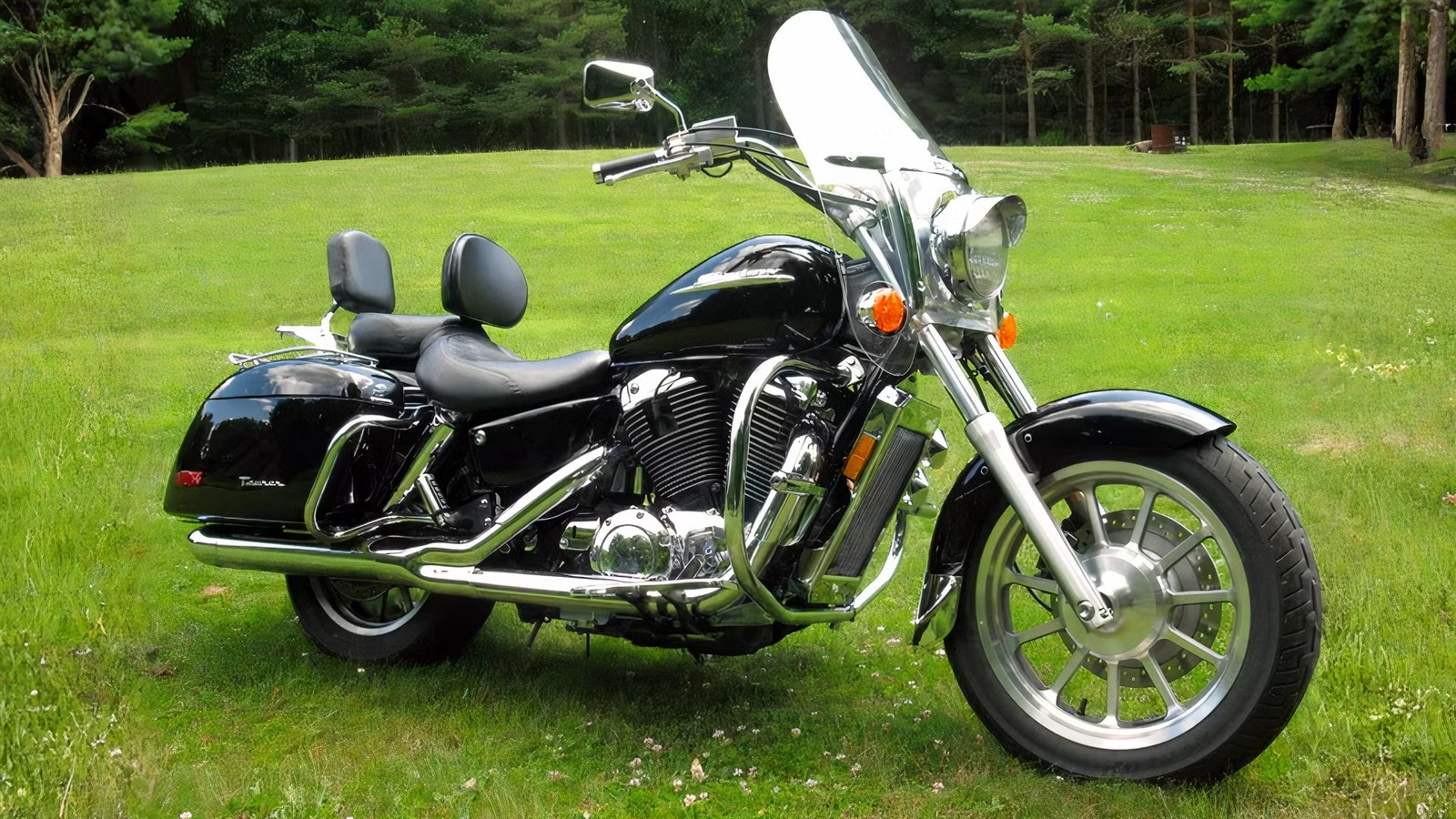
That candidate is the Honda VT1100T Shadow ACE Tourer, which Honda offered from 1998 through 2001. Unlike a standard cruiser dressed up after leaving the dealership, the Tourer arrived with a large windshield, locking color-matched hard saddlebags, a passenger backrest, floorboards, heel-and-toe shifting, and touring-oriented bodywork. It wasn’t trying to become a Gold Wing. It was a simpler V-twin alternative built for riders who still wanted to cross state lines.
The final version used a liquid-cooled, 1,099cc, 45-degree V-twin with an 87.5mm bore, 91.4mm stroke, and 8.0:1 compression ratio. Each cylinder had three valves and two spark plugs, while a pair of 36mm constant-velocity carburetors handled fueling. Hydraulic valve adjusters removed periodic clearance checks from the service schedule, and the engine sent power through a five-speed transmission, hydraulic clutch, and low-maintenance shaft final drive.

Published output figures vary, but estimates generally place the Tourer at approximately 60 to 67 horsepower and about 67 pound-feet of torque. More important than the precise peak figure is where the engine does its work. The long-stroke V-twin delivers its strongest response low in the rev range, giving the Tourer enough flexibility to build speed without demanding constant downshifts or making highway passes into carefully negotiated diplomatic events.
The Tourer also used the smoother dual-crankpin version of Honda’s 1,099cc engine rather than the shared-crankpin arrangement fitted to the standard ACE. That made it less lumpy and theatrical at idle, but also reduced vibration during extended highway riding. For a motorcycle intended to spend entire days on the road, sacrificing a little barroom swagger in exchange for smoother cruising was probably the more useful decision.
Used Prices Hover Around $4,000

Used examples of the VT1100T can still appear near the $4,000 mark. Valuation guides vary by year and condition, but they generally position usable Tourers in the low-to-mid-$3,000 range, with unusually clean examples commanding more. That’s a great deal of factory-equipped touring motorcycle for the price of many new small-displacement commuters.
Buying the Tourer also eliminates the need to assemble a travel package one accessory at a time. The windshield and hard luggage were engineered as part of the motorcycle, while the passenger accommodations are more convincing than the decorative rear pads attached to many cruisers. Its saddlebags aren’t enormous by current bagger standards, but they’re weather-resistant, lockable, and considerably more useful than throw-over leather bags dangling near hot exhaust pipes.

The standard equipment also helps preserve the value argument. A quality windshield, hard cases, mounting hardware, passenger backrest, and upgraded seating can easily add four figures to a basic cruiser. Starting with the Tourer means that money can instead go toward tires, suspension servicing, brakes, or other work that makes a decades-old motorcycle safer and more dependable.
Its Old-School Hardware Is Both The Appeal And The Catch

The Tourer’s mechanical simplicity is one reason it remains approachable, but age changes the calculation. Even the newest examples are now roughly a quarter-century old. The dual carburetors may need cleaning and synchronization, rubber intake parts can crack, cooling hoses can harden, and charging systems deserve inspection. A model with a strong reputation can still become unreliable when routine maintenance has been postponed by several owners.
Condition should therefore matter more than mileage alone. Buyers should inspect the cooling system, fork seals, steering-head bearings, wheel bearings, brake components, shaft-drive oil, and tire date codes. The hard saddlebags, hinges, locks, mounting brackets, windshield, and model-specific trim also deserve attention. Mechanical consumables can be replaced, but locating clean original touring bodywork may prove more difficult and expensive.
The brakes and suspension must also be judged by late-1990s cruiser standards. The Tourer is heavy, and its single front disc won’t provide the power or feedback of a modern touring motorcycle with twin rotors, radial calipers, and ABS. Its rear shocks may struggle after decades of service, especially with a passenger and loaded bags. None of this makes it unsuitable for distance riding, but it means the rider needs to respect the bike’s age and leave an appropriate margin.
Touring Preparation Matters More Than Cosmetic Condition
A prospective owner should prioritize a mechanically healthy, mostly stock example over the cheapest or most heavily customized bike. A proper baseline service may include engine oil, coolant, brake fluid, spark plugs, filters, carburetor inspection, fresh shaft-drive lubricant, and replacement tires when their age demands it. Charging voltage and battery health should also be checked before the motorcycle is trusted hundreds of miles from home.
The Shadow ACE Tourer won’t match a modern luxury tourer for braking, wind management, connectivity, or outright performance. What it offers instead is a low seat, stable chassis, smooth V-twin, factory luggage, shaft drive, and enough mechanical simplicity to make ownership manageable. For around $4,000 plus the cost of careful preparation, the VT1100T remains proof that a genuine long-distance hero doesn’t need a touchscreen, six ride modes, or a monthly payment.
Source: Honda Powersports, Honda Shadow Forums

Related posts


Latest Post


No Comments