
6 Forgotten Detroit Concepts Real Insiders Quietly Worship
Every year, automotive journalists and enthusiasts pick up their gear and head to international auto shows to witness the next leap in automotive technology. They witness the unveiling of some new cars and some wild concept cars. But these concept cars tend to follow a predictable script: they have absurd designs and promises of future technology that never make it to production. Cars like these serve as purely visual sculptures with no working mechanical parts.

But there is a second tier. These are the rare, fully engineered, running-and-driving prototypes that had the potential to rewrite the brand’s DNA if they had made it to production. They were crafted by passionate teams with some serious development budget behind them. But some of these concepts were so far ahead of their time and required a serious financial commitment that was not feasible. They represent the absolute peak of “what-if” engineering.
6
1954 Mercury XM-800
Year: 1954
The mid-1950s were defined by an intense styling war between Ford and GM. The 1954 Mercury XM-800 was a direct strike at GM’s design dominance, exemplified by its Motorama auto show. The XM-800 had a fiberglass body designed by John Najjar and was dropped over a functional Lincoln chassis powered by a potent 272 cubic-inch (4.4-liter) Y-block V8 engine. What makes the XM-800 an insider icon is how close it came to completely changing the trajectory of the Mercury brand.

Unlike many contemporaries, it was fully functional and traveled the country to various auto shows, which earned it a spot in the 1954 film Woman’s World. It introduced functional design features that would define the late ’50s: a heavily forward-canted grille, deeply recessed headlight pods, and a low, sweeping roofline that was significantly lower than any production car of the era. Ford management seriously considered greenlighting the XM-800 for full production to give Mercury a dedicated halo performance coupe.
But ultimately, corporate resources were diverted toward establishing Ford’s ill-fated Edsel division. Ford donated the one-of-one operational vehicle to the University of Michigan’s automotive engineering department, where it eventually passed into private hands. It was later found and purchased in 2008, underwent a meticulous frame-off restoration in 2009, and was auctioned in 2010 for $429,000. It may never have made production, but its design cues were later seen in cars like the Lincoln Premiere, Lincoln Capri, Mercury Montclair, and Ford Crown Victoria.

The Phantom Pontiac Muscle Car Most Gen-Z Enthusiasts Don’t Know About
This mysterious machine, hidden beneath the household names of Pontiac’s most famous models, remains one of the most intriguing ‘what if’ stories in the brand’s history.
5
1967 Ford Mach 2
Year: 1967

Ford Mustang Mach 2 Concept front three-quarters view
Long before the era of modern mid-engine performance cars, Ford’s high-performance masterminds were trying to figure out how to move their powerful V8 engines behind the driver. Following Ford’s historic victory over Ferrari at Le Mans with the GT40, design chief Gene Bordinat and Special Vehicles manager Roy Lunn teamed up to create an affordable, mid-engine sports car for the street. The result was the 1967 Ford Mach 2.
Using a highly modified Mustang platform, the team mounted a high-output 289 cubic-inch (4.7-liter) V8 right behind the driver. It was mated directly to a five-speed ZF manual transaxle. The fiberglass body had a clean, aerodynamic shape, retractable headlights, and a rear decklid that popped up to provide full access to the mid-engine powertrain. The Mach 2 wasn’t just another concept but a highly competent engineering mule tested extensively at Ford’s Dearborn test track.
It had a near-perfect weight distribution and balanced handling that outclassed front-engine production cars of the era. Despite its potential, the Mach 2 was deemed too expensive to manufacture, and the Mustang was already performing so strongly in the market. The project was quietly canceled and Ford would not make a serious attempt like this again until the Ford GT in 2005.
4
Chevrolet Aerovette
Year: 1976

The Chevrolet Aerovette is arguably the most famous mid-engine Corvette concept that never reached production. It represents the final, heartbreaking attempt by the “Father of the Corvette,” Zora Arkus-Duntov, to move America’s sports car to a mid-engine platform before his retirement. It started with the 1968 XP-880 Astro-II, 1970 XP-882, 1973 Reynolds Aluminum Corvette, and the Aerovette. There was even an attempt at a rotary version.
The engineers removed the experimental rotary engine and replaced it with a traditional, highly reliable 400 cubic-inch (6.5-liter) small-block V8. The design was a futuristic masterpiece with dramatic gullwing doors, a digital dashboard, and an incredibly low coefficient of drag. It was so well-received that GM corporate leadership approved the Aerovette for full production for the 1980 model year.
What went wrong? John DeLorean, who was running GM’s car and truck group at the time, argued that a traditional front-engine layout was significantly cheaper to produce and that sales numbers for the existing model were too strong to justify the financial risk. When Arkus-Duntov and design boss Bill Mitchell both retired from GM, the Aerovette lost its primary champions. The production order was revoked, forcing Corvette enthusiasts to wait over four decades to finally get a production mid-engine platform.
3
Pontiac Stinger
Year: 1989

In the late 1980s, Pontiac’s marketing leaned heavily into their “We Build Excitement” slogan. While most performance development went toward traditional muscle cars, a forward-thinking group of young designers anticipated the active lifestyle vehicles of the next century. The result was the 1989 Pontiac Stinger, a carbon-fiber-bodied, all-wheel-drive open-air vehicle finished in high-vis green paint.
The Stinger was packed with active lifestyle features. It was powered by a responsive 3.0-liter four-cylinder engine and sat on an adjustable pneumatic suspension system that could raise the ride height for off-road use. The real genius, however, was inside the vehicle. The door panels were completely hollowed out to hold removable matching gear, including a pull-out radio, a portable vacuum cleaner, a camping stove, and even detachable seats that could be converted into beach chairs.
While old-school performance purists overlooked it at the time, modern automotive enthusiasts have revered it for its remarkable foresight. It anticipated the entire sport-utility lifestyle explosion a decade before it happened. The Stinger was too complex and unconventional for GM’s conservative production lines, but its DNA directly influenced the crossover and adventure vehicles that dominate the modern automotive landscape.
The Ferrari-Powered Pontiac Concept GM Didn’t Want To Build
This concept merged American muscle with Italian elegance, but GM wasn’t interested in making it real.
2
Lincoln Sentinel
Year: 1996

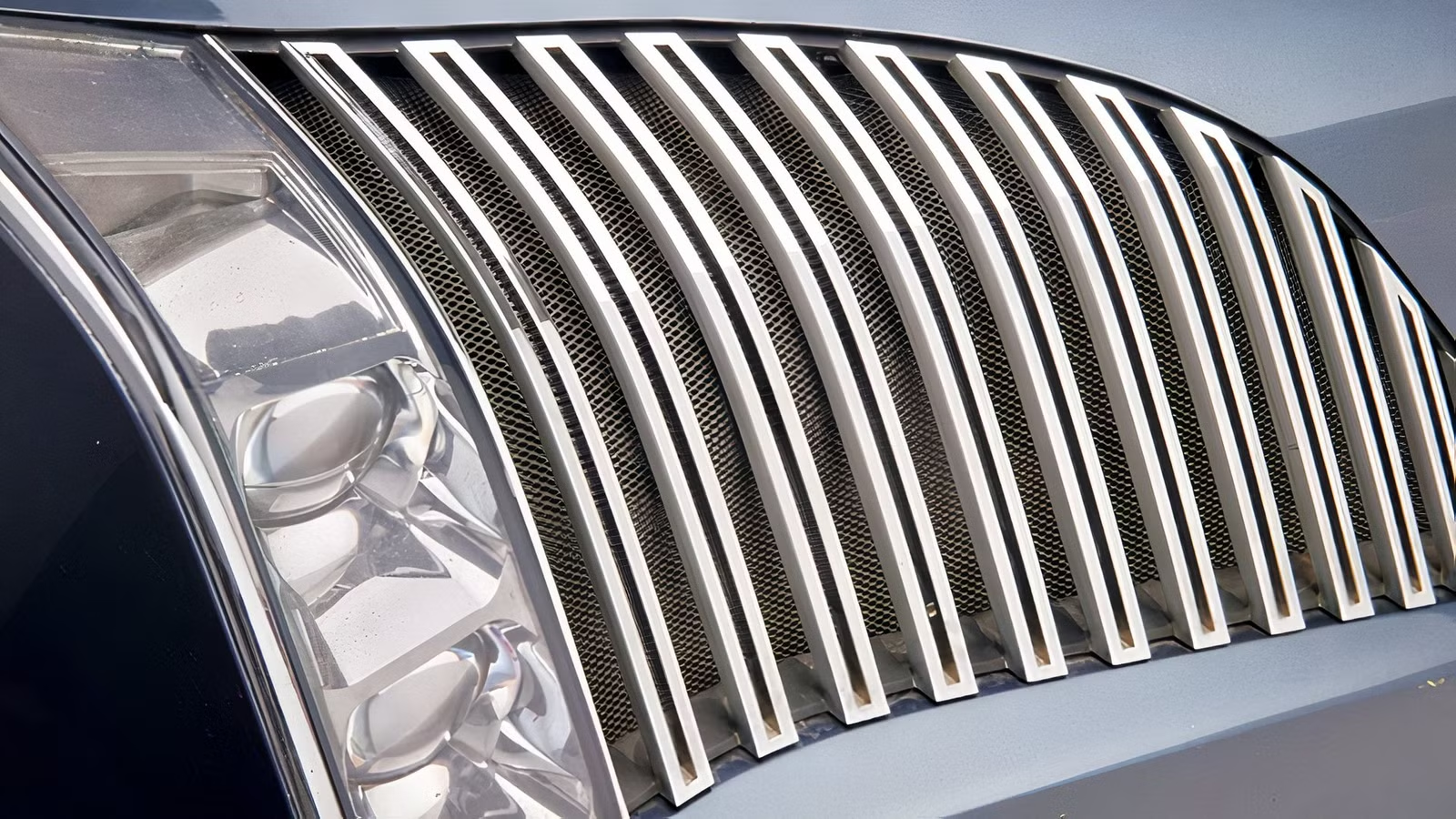
By the mid-1990s, luxury car design had become soft and uninspiring. Lincoln wanted an identity that resonated with younger luxury buyers while honoring its heritage. At the 1996 North American International Auto Show, they unveiled the Sentinel, a menacing luxury sedan that combined classic themes with ultra-modern design language. The Sentinel was a striking visual statement. It drew direct inspiration from the legendary 1961 Lincoln Continental and the classic 1930s flagship models. It had a prominent split-wing grille, sharp shoulder lines, 20-inch chrome wheels, and an imposing, low-slung black profile.
Under the hood was a functional 6.0-liter V12 engine built by joining two of Ford’s Duratec V6 engines. The Sentinel proved that American luxury could be genuinely imposing, elegant, and mechanically advanced without mimicking European luxury marques. The Sentinel was ultimately deemed too aggressive and expensive to produce, but some of its design elements were quietly integrated into Ford’s luxury production vehicles for the next decade, like the front grille on the Lincoln MKX.
We Saw The Upcoming Dodge Copperhead SRT, And Here’s What It Looks Like
Our friends at CarBuzz had a glimpse of the Copperhead SRT in person, and this is what Dodge seems to be cooking up.
1
Dodge Copperhead
Year: 1997

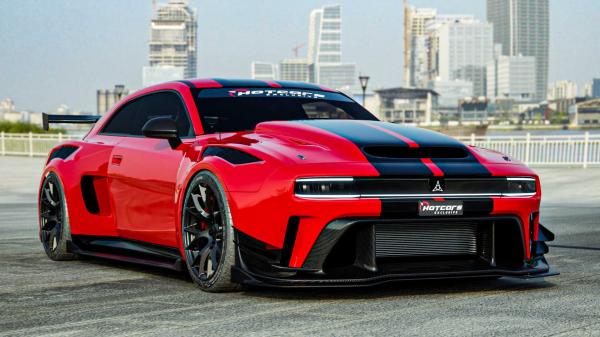
When Chrysler introduced the Dodge Viper in the early 1990s, it shook the automotive world. However, the Viper was an expensive V10 machine that demanded a skilled driver. In 1997, a small group of enthusiastic engineers wanted to see if they could capture that same raw performance magic in a smaller, more affordable, and precise package. The result was the Dodge Copperhead. It was finished in a striking metallic copper-orange paint and was designed as a pure handling machine. The wheels were pushed to the outermost corners of the chassis, widening the track to create exceptional cornering stability. Instead of the Viper’s massive V10, it was powered by an all-aluminum 2.7-liter V6 engine producing a solid 220 horsepower, linked to a close-ratio five-speed manual transmission.
The Copperhead was fully ready to go directly into production as an affordable roadster positioned right below the Viper. It was intended to compete directly with cars like the Mazda Miata, BMW Z3, and Porsche Boxster. However, just as the project was gaining momentum, Chrysler entered its massive corporate merger with Daimler-Benz. The restructuring shifted corporate priorities, and the Copperhead program was permanently shelved. But very recently, Dodge has confirmed the revival of the Copperhead name to be used on a new set of high-performance cars. Given the impact the Viper made, one can only wonder what the Copperhead would have achieved.
Sources: Chrysler, GM, Ford.

Related posts


Latest Post


No Comments