
The Mazda Four-Cylinder Engine Is So Reliable It’s Still In Production After Almost 20 Years
As electric cars continue to shift the modern automotive landscape, internal combustion engines still power millions of vehicles worldwide. Traditional gas-powered powertrains form a fundamental part of daily commuting, long-distance highway cruising, and the convenience of fast refueling. Electric vehicle adoption faces temporary hurdles, including charging infrastructure gaps, high initial purchasing costs, and battery longevity concerns.

Because of these factors, gas engines remain a core pillar of global transportation and will remain on public roads for many years to come. The primary driver for consumers purchasing a gas-powered car has been reemerging, as car prices rise and vehicle lifespans extend.
Mazda’s Focused And Dedicated North American Strategy
Mazda officially entered the U.S. in 1970 as an import brand that introduced American buyers to lightweight cars offering precise handling, and distinct mechanical engineering. The Japanese automaker built its original identity around the rotary engine, offering smooth power delivery in compact models including the RX-2, RX-3, and later the iconic RX-7 sports car. Beyond sports cars, Mazda applied a clear corporate philosophy to its everyday commuter vehicles. Its core philosophy promotes the idea of driving enjoyment without compromising on practical transportation.

Decades after its introduction, Mazda established a strong footprint across North America. The brand emphasized human-centric design, direct steering feedback, and chassis responsiveness. This was promoted via its “Zoom-Zoom” ethos, which it introduced via an aggressive marketing campaign in the early 2000s. While larger rival Japanese manufacturers focused heavily on maximum interior volume and appliance-like transportation, Mazda carved out a loyal following by building cars for people who genuinely enjoy driving. This dedicated focus on core engineering and driver connections continues to elevate Mazda from a niche importer into one of the most respected Japanese brands in the region.
Performance figures and technological features don’t carry much weight on purchasing choices among American consumers in 2026. Instead, engine reliability and efficiency now serve as the most critical factors in internal combustion design. You need a powertrain that runs efficiently, avoids unexpected failures, and lasts hundreds of thousands of miles without costly repairs. Mazda focuses on thermal efficiency, stress-resistant internal components, and robust mechanical simplicity earn long-term consumer trust in an increasingly complex market.
How Skyactiv Revolutionizes Performance And Reliability

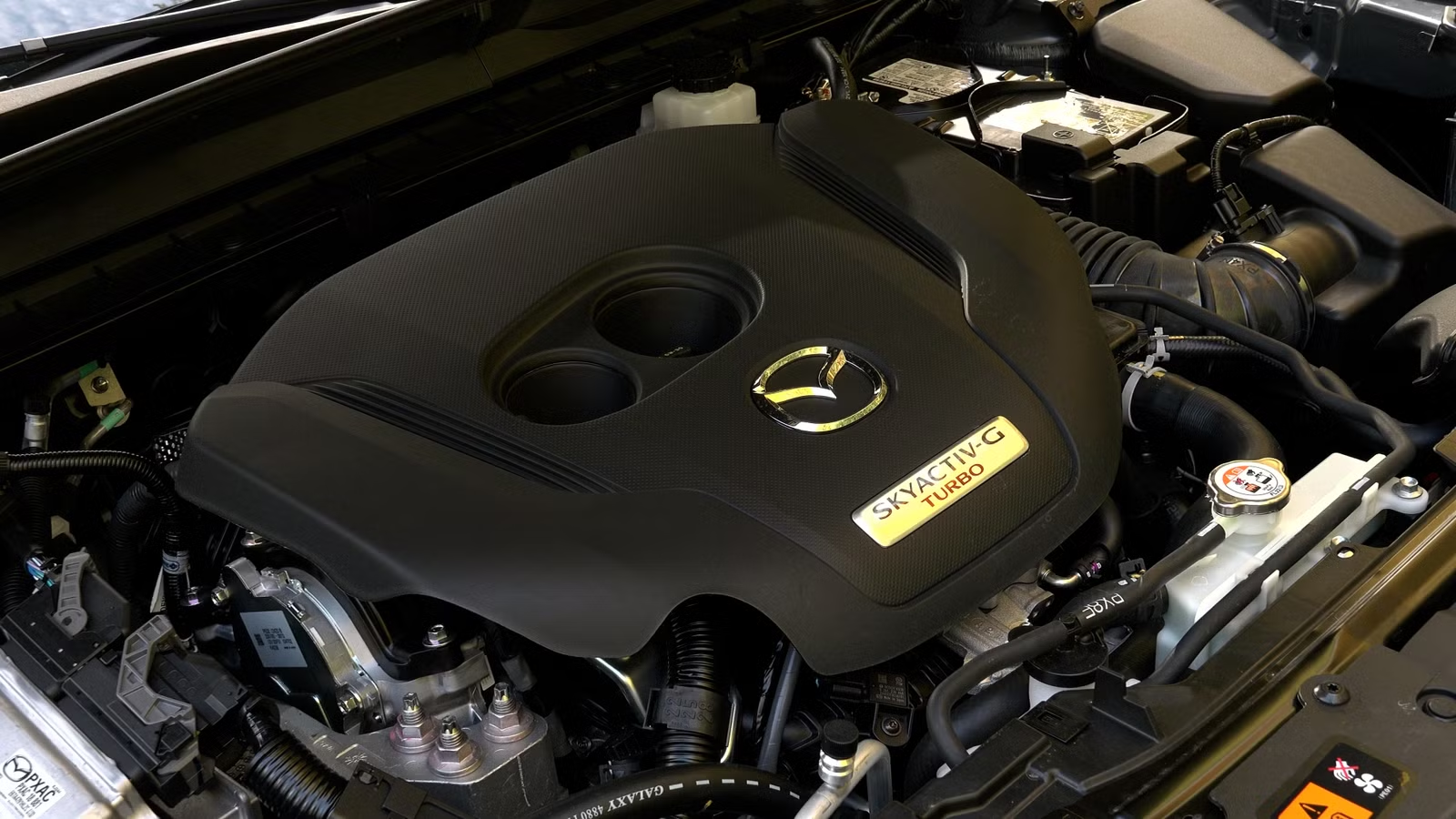
Mazda modernized its entire vehicle lineup with the introduction of its Skyactiv engine technology suite in 2011. Central to this strategy sits the Skyactiv-G engine, which Mazda applies to its current range. This is a naturally aspirated four-cylinder unit that the brand engineers to maximize combustion efficiency. It does so without resorting to heavy downsizing or complex forced-induction setups across all base trims. This family of engines stands out as one of the most reliable powertrains Mazda ever produces, prioritizing mechanical dependability and thermal efficiency over unnecessary complexity.
In 2026, Mazda continues to fit the proven Skyactiv-G engine across the vast majority of its product lineup. Variants of this four-cylinder engine power the Mazda3 sedan and hatchback, the CX-30 subcompact crossover, the CX-5 compact crossover, and the CX-50 overall lineup. Additionally, a specialized high-revving version powers the MX-5 Miata. While competing manufacturers transition their core lineups entirely to small-displacement, highly stressed three-cylinder turbo engines, Mazda maintains its naturally aspirated 2.5-liter four-cylinder foundation, offering consistent real-world reliability to modern car buyers.
The Genius Of Mazda’s Internals For The Skyactiv

The core design of the Skyactiv-G engine relies on structural rigidity and intensive thermal management. Engineers construct both the engine block and cylinder head from high-grade aluminum alloy, resulting in an exceptionally low overall weight. The defining mechanical feature of the naturally aspirated Skyactiv-G engine is its ultra-high compression ratio, reaching up to 14.0:1 in global markets and 13.0:1 in North American specs using regular pump gas. High compression normally causes engine knock or premature detonation, but Mazda resolves this issue by installing a long, tuned 4-2-1 exhaust manifold.
This specialized exhaust header draws hot residual exhaust gases out of the combustion chamber quickly, lowering cylinder temperatures before the next intake stroke. Mazda also incorporates multi-hole direct fuel injectors to precisely control fuel atomization and installs cavity pistons, designed to prevent the flame front from prematurely hitting the piston top. These components allow the engine to optimize the energy released in each combustion cycle.
Across the current vehicle lineup, the naturally aspirated 2.5-liter Skyactiv-G produces 191 horsepower and 186 pound-feet of torque. The high-revving 2.0-liter variant in the MX-5 Miata generates 181 hp and 151 lb-ft. For larger crossover applications, the turbocharged 2.5-liter variant generates up to 250 hp and 320 lb-ft on premium fuel. Mazda couples these engines to either a precise six-speed manual transmission or a traditional six-speed torque-converter automatic transmission, avoiding multi-ratio continuously variable transmissions that often introduce long-term durability issues.
How To Ensure Your Skyactiv Will Really Last Forever

While the Skyactiv-G is a reliable engine, it requires adherence to basic maintenance schedules if you want it to cover more than 200,000 miles. Standard maintenance includes a synthetic engine oil and filter change every 5,000 to 7,500 miles under normal driving conditions. Engine air filter replacements occur every 15,000 to 30,000 miles depending on local road conditions. Because the engine uses direct fuel injection, replacing spark plugs at the recommended 75,000-mile interval prevents misfires and maintains optimal combustion clarity.
Coolant flushes should occur at 120,000 miles or 10 years of service. Standard oil change services average under 100 dollars at independent mechanics or dealership service bays, keeping routine ownership costs minimal. Regarding safety recalls, the Skyactiv-G four-cylinder engine exhibits an exceptionally clean track record across nearly two decades of production. While minor recall campaigns occasionally surface for auxiliary components, such as low-pressure fuel pump impeller software updates or cylinder-deactivation hydraulic valve lifter recalibrations on select 2018 and 2019 models, the core mechanical assembly has never been subject to widespread engine block, crankshaft, or catastrophic timing chain safety recalls. The internal rotating assembly, cylinder heads, and valve train demonstrate consistent structural integrity throughout long-term customer use.
The Impressive Origins Of Mazda’s Naturally Aspirated Engine

Mazda launched the first true iteration of the Skyactiv-G engine in the U.S. market for the 2012 model year, fitting a 2.0-liter variant into the refreshed third-generation Mazda3. Before this launch, compact cars relied on traditional engine designs that forced buyers to choose between adequate acceleration and good fuel economy. The 2012 Mazda3 Skyactiv broke that compromise, featuring a 2.0-liter naturally aspirated inline-four that produced 155 hp at 6,000 RPM and 148 lb-ft at 4,100 RPM, achieving an EPA-estimated 39 MPG on the highway without using hybrid batteries or CVTs.
Automotive journalists and everyday consumers praised the vehicle upon arrival. Review aggregation sites like Edmunds record high customer ratings for the 2012 Skyactiv-equipped Mazda3, maintaining an average user score of 4.4 out of 5 stars across 117 verified owner reviews. Owners highlight the linear power delivery, smooth engine revs, and accurate real-world fuel economy figures that match or exceed factory EPA estimates. The initial success of this 2012 model validated Mazda’s engineering direction and laid the groundwork for the brand to roll out Skyactiv technology across its entire vehicle catalog over the next decade.
How Mazda Applies The Skyactiv In 2026

When we ask what the Skyactiv engine does for owners in practice, it’s best to evaluate the current CX-5. The 2026 Mazda CX-5 holds a respectable reputation among reviewers and owners. iSeeCars gives it an 8.0/10 overall score. This includes a 7.9/10 for reliability, an 8.2/10 for retained value, and 8.0/10 for safety. On the reliability front, you can expect the Japanese SUV to cover an average lifespan of 14.5 years or 167,897 miles, with a 25.3 percent probability of reaching 200,000 miles.
On the value retention front, the CX-5 is likely to lose $11,364 or 39.9 percent of its value after being used for five years or 60,000 miles, which is slightly better than the rest of the midsize SUV segment. The 2026 Mazda CX-5 benefits from an 82/100 consumer-verified overall score from J.D. Power, which includes 82/100 for quality and reliability, 79/100 for the driving experience, 84/100 for resale, and 82/100 for the dealership experience.
The Future Of Mazda’s ICE Division

Mazda continues to invest heavily in internal combustion technology, refusing to abandon gas engines as other brands shift entirely to battery-electric platforms. The automaker is currently developing its next-generation four-cylinder engine architecture, designated as Skyactiv-Z, which it plans to introduce in the 2027 CX-5. This upcoming engine family focuses on achieving Lambda 1 combustion efficiency across the entire engine operating range. By maintaining a stoichiometric air-fuel ratio during hard acceleration and high-load cruising, the engine reduces carbon emissions while squeezing maximum kinetic energy from every combustion cycle.
Furthermore, Mazda designs these future internal combustion powerplants to integrate directly with scalable electrification systems. The company pairs its four-cylinder engines with 48-volt mild-hybrid setups, plug-in hybrid powertrains, and flexible rotary range-extenders. Thanks to these intelligent designs, Mazda future-proofs its gas engines to meet global emissions standards without sacrificing long-term reliability. The goal is to modernize combustion thermal dynamics rather than overcomplicating mechanical internals.

Available Models
Mazda
- Founded
-
January 30, 1920 (as Toyo Cork Kogyo Co)
- Founder
-
Jujiro Matsuda
- Headquarters
-
Hiroshima, Japan
- Owned By
-
Publicly Traded
- Current CEO
-
Masahiro Moro
Sources: Mazda, Edmunds, J.D. Power, iSeeCars, Motor Reviewer, and the EPA.

Related posts





Latest Post


No Comments