
The 1967 Gorries Black Panther Camaro 427
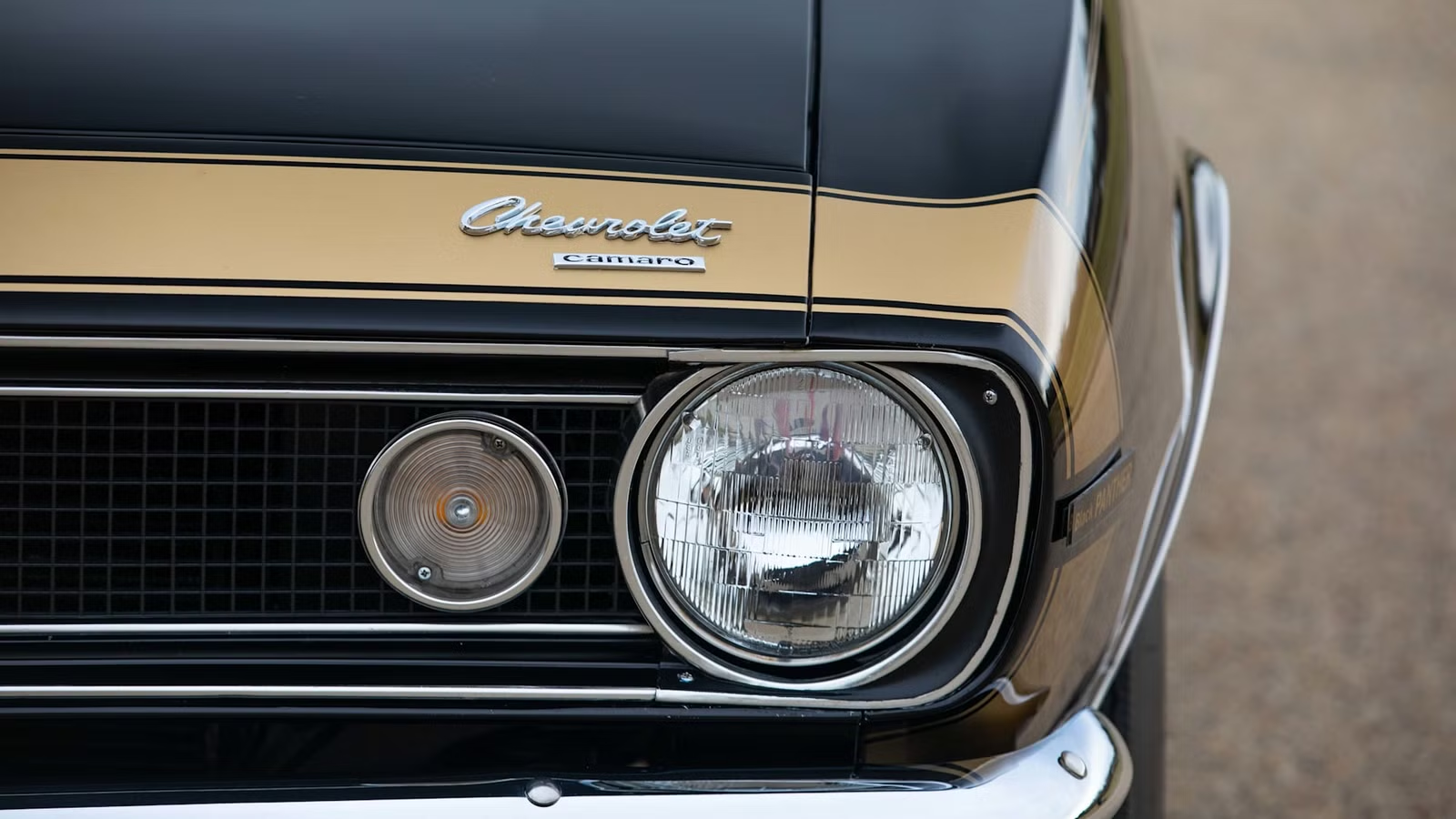
In May 1967, an unassuming Canadian policeman was waiting for speeders when a low black muscle car blew by like a rocket ship taking off. When the officer finally caught up, the driver introduced himself as an automotive journalist testing a new car: the 1967 Camaro. But that’s not all, the vehicle in question was a unique black and gold edition with an aftermarket 427 cu-in big block V8, racing suspension upgrades, and a side-exit exhaust that you could hear a mile away. And no, it wasn’t a Yenko.
The Best Muscle Car Special Editions Were Built By Dealerships

Today, automakers offer all kinds of special editions assembled in the factory. Until 2022, Ford built Shelby-badged GT500s in-house. You want an American Expedition Vehicle Colorado? General Motors will build one of those in its factory, too. And of course, Dodge spent more than a decade slapping superchargers onto V8 Chargers and Challengers, no aftermarket tuner needed. But buying a special edition used to be very different. In the 1960s and 70s, you needed a dealership’s help.
Take, for example, when Cincinnati introduced the Bengals NFL team in 1968. Dodge dealership owner Tom Kneer searched through the paint catalog, found an industrial orange similar to the new team’s color, and ordered 50 Chargers wearing it. Then he installed custom stripes, badges, and interiors to build the Bengal Dodge Charger.

Other dealerships offered performance editions for racers and enthusiasts. Mr. Norm’s Grand Spaulding Dodge in Chicago hand-built multiple “Grand Spaulding Editions.” The legendary GSS Dart was notable for installing a big-block V8 in an “A-body” compact car, a combination Dodge never mass-produced.

Yenko Built A Big-Block Camaro

General Motors debuted its answer to the Mustang pony car class for the 1967 model year: the Chevy Camaro. The automaker famously refused to offer any engines larger than 400 cu-in in the small car. What other dealerships saw as a frustration, Don Yenko of Ohio saw as an opportunity.
Yenko Chevrolet ordered 54 1967 SS Camaros equipped with the 396 cu-in “L78” V8. Then it yanked the engines and dropped in the 427 cu-in (7.0-liter) “L72” V8.

The L72, which had originally been rated at 450 horsepower, was the most powerful engine available in full-size Chevrolets. In the pint-size Yenko Camaro, it made for a serious performance upgrade.
Yenko Camaros proved popular among drag races and enthusiasts nationwide. Don Yenko kept building them through the 1969 model year. That said, he was far from the only dealership owner with this idea. And one Canadian dealership did it with even more style.
Gorries’ 1967 “Black Panther” Carried A 427 V8 And A Whole Lot Of Style

Gorries Chevrolet was located in downtown Toronto. Like many dealership operators, Gorries’ owner and president—Burke Seitz—was looking forward to the Chevy project codenamed “Panther” that promised to take on the Mustang. Then the 1967 Camaro arrived in his showroom, and he felt the name was a bit of a letdown. So he decided to badge his own “Panther.”
The Gorries “Black Panther” was the appearance package the dealership offered on its custom 1967 Camaros. They all started out as black cars with gold interiors before receiving a series of custom gold stripes, “Black Panther” badges, and a series of unique callouts in the interior.

Customers could order the car with its base engine, a 327 cu-in V8. They could get the Black Panther treatment on a Camaro Z/28, which Chevrolet had engineered for road racing courses. Canadian driver Craig Fisher did exactly this and competed in Trans-Am with his special Black Panther livery. At Daytona, Fisher was actually the first driver to score Trans-Am Series points in a Camaro.
Black Panther buyers even had a third engine option. Gorries offered a Black Panther trim with a big-block 427 cu-in V8 in the engine bay. But the dealership didn’t stop at an engine swap. The race-ready car came with a 4-speed Muncie transmission, limited-slip differential, heavy-duty coil springs up front, custom rear leaf springs to prevent wheel hop, and large rims wrapped in UniRoyal “Tiger Paw” redline performance tires. The Black Panther was undoubtedly the Yenko of the north. And it oozed unique style.
The Black Panther Was An Unforgettable Head-Turner

Peter Bone of Canada Track & Traffic magazine took a Black Panther 427 out for a spin. Before a “friendly warning” from “a member of the local constabulary,” he tested its 0-60 time on a wet road at 6.8 seconds. “In the dry this could probably get down below six.”
Burke Seitz’s son, Bob Seitz, was too young to drive a Black Panther. But he remembers a very different feature than the acceleration. When the Gorries team assembled the prototype, they installed a “007 panel” in the center console. It featured eight golden dummy switches and labels: Axle Extension, Smoke Screen, Machine Guns, Ejection Seat, Bullet Shield, Radar Track, Oil Slick, and Laser Beam.” When customers noticed this “gimmick,” they demanded their own. So Gorries made the “007 panel” a $27 option on the order sheet.

Bob Seitz said, “I do remember sitting in it in our driveway, pushing all the buttons on the console, probably fantasizing about firing missiles at my older sisters! The Black Panther was very Bond, and as a kid it was magic.”
Bob Simonen was a bit older in 1967. He’d been married three years when his wife sent him and a friend into Toronto to buy a sensible daily driver. In 2016, Simonen told his local newspaper the whole story. “The Black Panther Camaro was in the showroom. I fell in love immediately. I’d never seen a car that was black and gold or had mag wheels before.”

Lorraine Simonen walked outside the next morning and said, “That’s a daily driver huh?” But Bob Simonen put his money where his mouth was and drove the car until 1980. He restored it in 2002 to take around the car show circuit. In 2016, he said, “I’m still in love with the vehicle. I didn’t buy it as an investment, I just really loved the car. My wife and I have enjoyed many great times in the vehicle.”
An Undervalued Chapter Of Camaro History

Unlike the Yenko Camaro, the Black Panther was only available for one model year. Historians estimate Gorries built between 30 and 50. Many of the more powerful cars were likely pressed into racing duty, repainted with racing liveries, or crashed. Today, just three known examples exist.

Simonen’s VIN 124377N190540 has an automatic transmission and the base 327 cu-in V8. That said, it’s a single-family-owned car with 52,343 miles, and easily the most immaculate Black Panther Camaro on the road today. It even had the “007 panel.” In 2020, the family finally decided to send it to Mecum Auctions. It sold for $52,800. Meanwhile, the lowest sale price for a Yenko Camaro over the past 12 months was $308,000. $52,800 is an astoundingly low price for such a fascinating piece of muscle car history.
Sources: SooToday, International Motor Sports Association, Classic.com, Canada Track & Traffic: May, 1967

Related posts
Latest Post


No Comments