
When Toyota Made S-Class Buyers Feel Cheated
If you dropped serious cash on a flagship luxury sedan in the 1990s, the Mercedes-Benz W140 S-Class was the undisputed heavyweight champion. Mercedes-Benz invested a fortune into making it a rolling vault of hyper-engineered dominance, and by the end of the decade, it was the default chariot for global elites.

During the endless board meetings between every department involved in the W140 development, Mercedes-Benz must have anticipated their new shiny flagship’s strongest opposition to come from familiar continental rivals. The BMW 7 Series (E38), the inaugural Audi A8, and maybe a Bentley or Rolls-Royce for those with deeper pockets. Little did Stuttgart know that the knockout blow would come from across the Pacific, wearing the least expected badge: Toyota. In a quiet corner of Toyota’s Higashi-Fuji plant, a handful of master craftsmen were building something that threatened the dominance of Germany’s finest luxury sedans.
Why The W140 S-Class Became The Luxury Benchmark
To understand how high Toyota had to aim, you have to understand the sheer absurdity of the W140-generation S-Class, which debuted in 1991. Legend has it that Mercedes poured a staggering $1 billion into its development. The project ran so far over time and budget that it famously cost chief engineer Wolfgang Peter his job.

But the result was worth every penny. The W140 combined tank-like build quality, sheer luxury, and advanced technologies to create an irresistible package for luxury shoppers. Not to mention, it housed some of the most powerful engines available at the time, including the flagship 6.0-liter M120 V12 engine found in the top-tier 600 SEL and later S600 trims. There was even an AMG-tuned version for those who wanted to chase down sports cars in a luxury land yacht. As great as the W140 was, Toyota was quietly working on something that would unseat it at the top of the luxury sedan hierarchy.
This Unkillable ’90s Lexus Sleeper Sedan Is Now A Secret Bargain
The Lexus GS 400 is a forgotten ’90s V8 sedan with Toyota reliability and luxury, now selling cheap and running for hundreds of thousands of miles.
Toyota’s Quiet Counterattack On German Luxury

While most giant automakers built their name on performance and luxury, Toyota went a different route. Decades ago, Toyota realized that reliability sold far more cars than performance or luxury ever could. Since then, Toyota has built a reputation for selling bulletproof cars that easily handle hundreds of thousands of miles with regular maintenance, a strategy that has propelled the company to the top of all-time sales charts.
Toyota knows its core customers don’t expect luxury when they buy anything with its badge, and the company even went as far as setting up the Lexus division to serve customers who wanted luxury mixed with that Toyota reliability DNA. But long before Lexus existed, Toyota created a nameplate aimed at capturing the local luxury market, which was dominated by European brands at the time. This luxury sedan was designed specifically for the domestic Japanese market, prioritizing local tastes over global appeal.
The first generation worked great for several decades and eventually became the go-to car for Japan’s political class and business elites. While the second-generation model was still primarily targeted at the Japanese domestic market when it debuted in 1997, Toyota created it as a direct counterpunch to the W140 and other popular European luxury sedans, arming it with V12 power and hand-crafted luxury features that proved Toyota could match — or even beat — the Germans at their own game.
1997 Toyota Century V12: When Toyota Outclassed The Mercedes S-Class

The vehicle that quietly disrupted the established luxury hierarchy was the second-generation GZG50 Toyota Century, which debuted in 1997. The Century name traces all the way back to 1967, when Toyota launched it to celebrate the 100th birthday of founder Sakichi Toyoda, but the second-generation model elevated the nameplate to mythic status.
This wasn’t a mass-market product you could just walk into a dealership and buy. It was sold in Japan and favored by executives, dignitaries, and other high-profile buyers. On paper, its performance figures wouldn’t scare a sports car. But the Century was never about numbers; it was about an unmatched sense of occasion. It possessed an intangible air of absolute authority and became the ultimate symbol of understated luxury.
Hand-Built Luxury, Japanese Style

The material differences between the W140 and the Century highlight two fundamentally opposing philosophies of luxury. While Mercedes-Benz assembled the W140 on a traditional, automated production line, Toyota treated the Century like a piece of high art. It was built in a specialized, low-volume facility where Japan’s finest master craftsmen, known as Takumi, hand-fitted every single component with microscopic accuracy.
Step inside, and the contrast with German luxury becomes a culture shock. There was minimal flashy leather in the Century. Instead, it featured exquisite, hand-finished wool cloth seats and door panels. Why wool? Because, unlike leather, premium wool is completely silent when you move, it isn’t uncomfortably hot in summer, and it won’t creak against your bespoke suit.
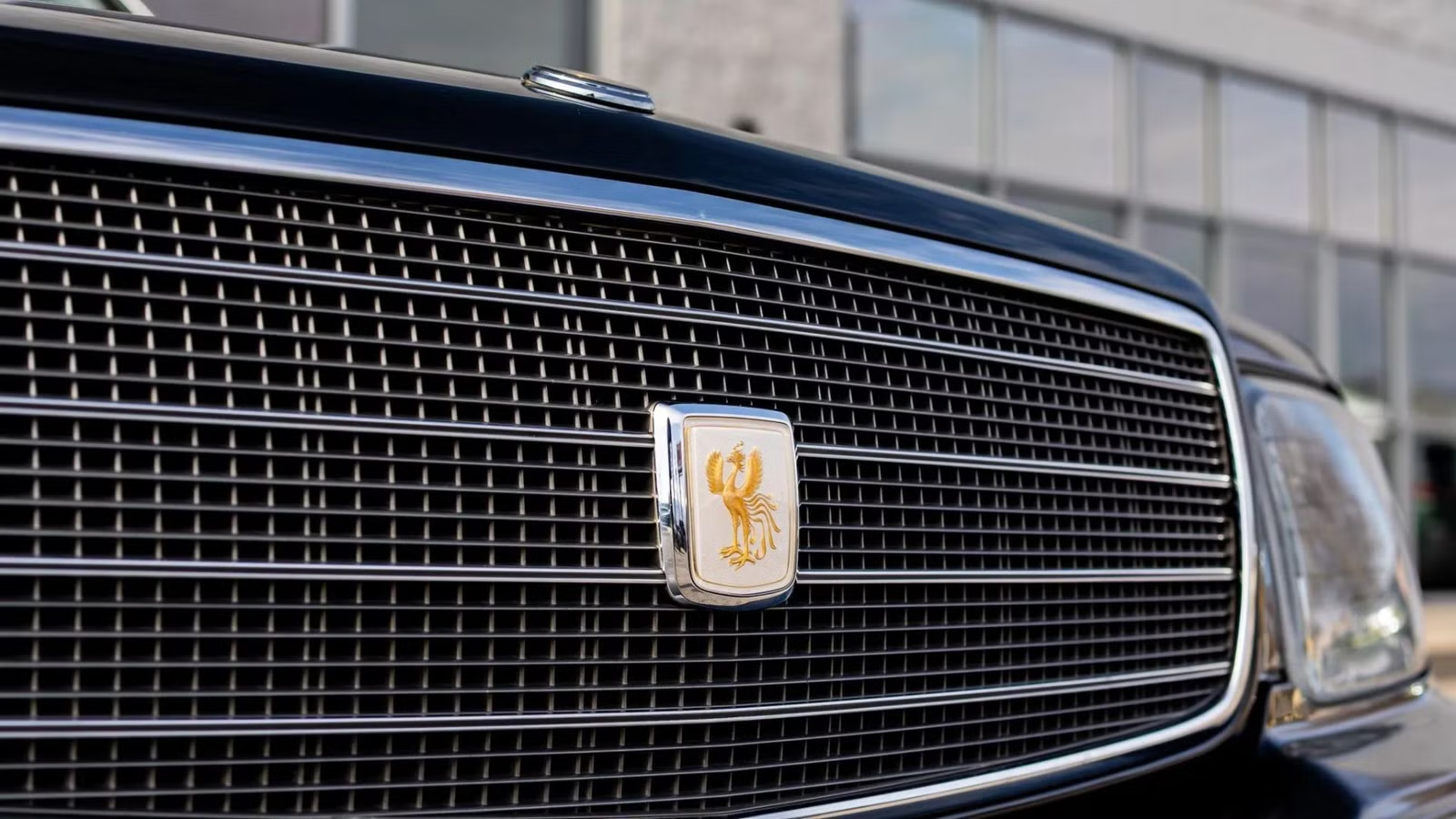
Executives enjoyed a private sanctuary featuring VIP insulation, double-pane glass, power-reclining heated seats, built-in massagers, a front seatback pass-through, a phone, and motorized privacy curtains. This JDM unicorn redefined automotive opulence, but even more impressive was the power plant hiding behind the ornate grille.
What Made The 1GZ-FE So Absurdly Overbuilt

Beneath the Century’s unassuming hood lay an absolute masterpiece of mechanical overengineering: the 1GZ-FE V12. Developed exclusively for the Century, this 5.0-liter mill is historically significant as it’s Japan’s only mass-produced passenger-car V12. Thanks to Japan’s 1990s “gentleman’s agreement,” the 1GZ-FE was officially rated at a modest 276 horsepower, though it put down a healthy 340 lb-ft of torque. While it looked completely outmatched by the W140’s 389 hp M120 V12, the 1GZ-FE compensated by offering massive low-end torque and an almost eerie absence of secondary engine vibrations — features that appealed more to the target market than top-end performance. In fact, the engine idled with such zero-vibration perfection that you could balance a coin on the intake manifold without it tipping over.
Even more impressive was the engine’s exceptional reliability. The 1GZ-FE engine was built to prove luxury cars could be reliable, but what made it light years ahead of time was the dual-ECU architecture that allowed it to run two completely independent engine management systems. In other words, it was designed more as two inline-six engines working together under one hood than as a single V12 unit. If a sensor or fuel pump failed on one side, the car wouldn’t stall. It could keep running on one bank in an emergency, ensuring the dignitary in the back would never have to wait for a tow truck.
The Legendary Car From 50 Years Back That Wouldn’t Feel Out Of Place In 2026
This timeless classic set the tone for Mercedes-Benz design and engineering for two decades to come and had a major influence on the entire industry.
Why the Century Stayed Hidden While The S-Class Became A Global Status Symbol

So, if the second-generation Century was so good, why didn’t it become a global icon like the W140? Simple: Toyota deliberately kept its masterpiece a secret. While Mercedes-Benz aggressively pushed the S-Class into every major global market, Toyota restricted the Century primarily to Japan, exporting only a microscopic handful to select diplomats.
Then there was the badge. To Western buyers, dropping a fortune on a car carrying the same badge as a Corolla was unthinkable. The prestige of the three-pointed star reigned supreme. Because the Century remained locked away in its domestic market, Western car enthusiasts had no idea it even existed. This total lack of recognition suppressed its global used-market values for decades, but the tide may be shifting.
Maserati Won’t Abandon The Third Pedal—And Enthusiasts Should Care
Maserati says the manual isn’t dead yet, and that matters more now than most enthusiasts realize.
From Forbidden Fruit To Underrated Collectible

The Century stayed hidden from the U.S. market for decades, but thanks to the 25-year import exemption rule, early examples of this magnificent V12 flagship are finally arriving on North American soil. Suddenly, a hand-built V12 limousine is perfectly legal to park in an American garage. The best part? The market hasn’t fully recognized how special this car is yet, making it a compelling bargain.
The average price for a second-gen Century hovers around a modest $14,000, which is shocking for a hand-crafted, over-engineered masterpiece with a V12 up front. However, the secret is rapidly getting out. A pristine 1997 example sold for a jaw-dropping $39,000 at an auction in April 2026, showing that the days of buying these Japanese flagships for pocket change are officially numbered.
Century Vs. W140 S600: Why The Toyota Is The Smarter V12 Flex

From an investment and ownership perspective, the head-to-head match-up between these two flagships reveals a stark contrast in value. The average price of a W140 sedan is $27,166 across all variants. Certainly, you can find an early 600 SE or SEL for a price comparable to the Century V12. But if you want a late-model, face-lifted S600 (1994–1999) where Mercedes fixed some of the early gremlins, you are looking at a staggering market average of $41,719.
When choosing where to allocate your collector capital, the Japanese masterpiece presents an unassailable case. The lower price certainly makes the case for it, and owners who intend to drive their cars regularly can expect better reliability and lower maintenance costs. But ultimately, it is the Century’s absolute scarcity on North American roads, its deep cultural novelty, and its peerless luxury execution that frame it as the genuinely smarter V12 acquisition.
Sources: Classic.com, Bring a Trailer

Related posts



Latest Post


No Comments