
10 Twin-Cam Four-Cylinder Classics Enthusiasts Hunt
The V8 gets the headlines. It always has. But there is a different kind of enthusiasm operating at the margins, one that belongs to the four-cylinder faithful who know exactly what a twin-cam engine does when it is properly engineered and properly liberated. These are not economy units with sporting pretensions. They are purpose-built machines with double overhead camshafts, high-revving character, and competition pedigrees that the mainstream glosses over. Some are genuinely obscure. Some you already know. All of them deserve more respect than they get, and all of them have a dedicated community tracking down the classic cars that carry them.
10
Lotus/Ford Twin Cam
105 hp, 6,500 rpm
 31 autotech Make and Model |
Power and Torque |
0-60 mph |
 95 autotech Top Speed |
Avg. Price |
|---|---|---|---|---|
|
Lotus Elan S1 (1962–68) |
105 hp / 108 lb-ft |
7.5 sec |
115 mph |
$25,000–$45,000 |
Harry Mundy designed the twin-cam aluminum head, fitting it to the Ford Kent iron block to create one of the most significant production four-cylinders ever fitted to a road car. The Lotus Elan received it in 1962, producing around 105 hp in standard tune, and it was receptive enough to tuning that race versions reached well beyond 170 hp. It also found its way into the Lotus Cortina and the Ford Escort Twin Cam, two cars that turned club racing on its head. Finding a Lotus-assembled unit versus a later Cosworth-built example is the first conversation in any serious Elan acquisition. The community that maintains these engines is meticulous and unforgiving on specification.
10 Fastest Turbocharged Four-Cylinder Cars That Can Outrun Muscle Cars
These overachieving four-bangers might convince you that there is a replacement for displacement after all – turbos.
9
Alfa Romeo Nord Twin Cam
113 hp, 6,500 rpm

|
Make and Model |
Power and Torque |
0-60 mph |
Top Speed |
Avg. Price |
|---|---|---|---|---|
|
Alfa Romeo Giulia GTA 1600 (1965–69) |
113 hp / 104 lb-ft |
8.1 sec |
118 mph |
$40,000–$80,000+ |
Giuseppe Busso’s all-aluminum twin cam entered production in 1954 and ran until 1994. Forty years. The engine that powered the Giulietta, the Giulia, and the GTA featured a fully aluminum block and head at a time when most manufacturers considered an aluminum head ambitious. In GTA road specification it produced 113 hp from 1,570 cc, which in a 795 kg car was extraordinary for 1965. The rebuild community treats every correct-specification Giulia engine as a restoration priority rather than a parts-swap opportunity. The Nord’s sound at 6,000 rpm is part of its mythology. The engineering underneath that sound is why it belongs in any serious DOHC four list.
8
Fiat/Lampredi Twin Cam
118 hp, 6,500 rpm

|
Make and Model |
Power and Torque |
0-60 mph |
Top Speed |
Avg. Price |
|---|---|---|---|---|
|
Fiat 124 Spider (1966–85) |
118 hp / 114 lb-ft |
9.5 sec |
112 mph |
$15,000–$25,000 |
Aurelio Lampredi designed this engine after leaving Ferrari, and it ran in continuous production from 1966 to 2000: thirty-four years, ten WRC manufacturers’ championships, and applications ranging from the Fiat 124 Spider to the Lancia Delta Integrale. The engine was so adaptable that it powered rally cars, road cars, and racing specials across five decades without fundamental redesign. The Fiat 124 Spider community keeps the rebuild culture most visibly alive, but it is the Lancia Beta Montecarlo and the 131 Abarth applications where the engine’s competition character becomes undeniable. Few four-cylinders have achieved this much in this many contexts.
7
Ford Cosworth BDA
120 hp, 9,000+ rpm

|
Make and Model |
Power and Torque |
0-60 mph |
Top Speed |
Avg. Price |
|---|---|---|---|---|
|
Ford Escort RS1600 (1970–75) |
120 hp / 112 lb-ft |
8.5 sec |
113 mph |
$35,000–$60,000 |
The BDA, which stands for Belt Drive A-type, was Cosworth’s answer to what a production four-cylinder could be when nobody told it to compromise. Built on a Ford Kent iron block with a DOHC sixteen-valve head derived from the DFV Formula 1 engine, it was engineered from day one for competition. The Escort RS1600 was the homologation vehicle; the race program was the point. In full BDG Formula 2 specification it reached 280 hp at 9,250 rpm. On the road it produced 120 hp and a redline that made everything around it feel agricultural. Rebuilt examples command serious money, the community that maintains them is exacting, and finding a numbers-correct RS1600 is a project in itself.
6
Nissan SR20DE
140 hp, 7,000 rpm

|
Make and Model |
Power and Torque |
0-60 mph |
Top Speed |
Avg. Price |
|---|---|---|---|---|
|
Nissan Primera GT P10 (1990–96) |
140 hp / 132 lb-ft |
7.8 sec |
130 mph |
$5,000–$12,000 |
The SR20DE does not get discussed in the same breath as the 4A-GE or the B16A, but it should. The naturally aspirated 2.0-liter twin-cam that powered the P10 Primera, the Nissan SE-R, and a generation of touring car competition is a high-revving, mechanically robust unit with a cleaner top-end character than most of what it competed against. The Primera became the first Japanese car to win the BTCC manufacturers’ title in 1997 with the P11, and in 1999 Laurent Aïello swept the drivers, manufacturers, and team titles in one of the most dominant campaigns the series had seen. On the road it is smooth, strong above 5,500 rpm, and more rewarding to drive than its reputation suggests. The cars that carry it are still undervalued, which means the window to buy a good one without paying discovery tax is open, but not indefinitely.
5
Honda B16A VTEC
160 hp, 7,600 rpm

|
Make and Model |
Power and Torque |
0-60 mph |
Top Speed |
Avg. Price |
|---|---|---|---|---|
|
Honda Civic SiR EF (1989–91) |
160 hp / 111 lb-ft |
7.8 sec |
130 mph |
$10,000–$20,000 |
Yes, it is widely known. That does not disqualify it. The B16A belongs here because it was the first production engine to hit 100 hp per liter without forced induction and because the VTEC system it introduced in 1989 was not a marketing exercise. It was a genuinely clever solution to the conflict between low-rpm tractability and high-rpm power. The crossover at 5,500 rpm is the engine changing its personality on command, and thirty-five years later it still delivers that moment with the same mechanical drama. The EF Civic SiR chassis that originally carried it is now a legitimate collectors’ target. Clean, unmodified examples are becoming harder to find. That window is closing.
4
Toyota 4A-GE 20V
165 hp, 7,800 rpm

|
Make and Model |
Power and Torque |
0-60 mph |
Top Speed |
Avg. Price |
|---|---|---|---|---|
|
Toyota AE111 Corolla Levin (1995–2000) |
165 hp / 116 lb-ft |
7.2 sec |
130 mph |
$15,000–$35,000 |
You already know the 4A-GE. You know the AE86. What you might not know is that the 20-valve Black Top, the final evolution of the engine in the AE111, represents the apex of what Toyota’s engineers could extract from a 1.6-liter naturally aspirated four-cylinder with individual throttle bodies and variable valve timing. One hundred and three horsepower per liter in 1995, without a turbocharger. The engine revs to 7,800 rpm and the power does not arrive until it absolutely means it, which is exactly the point. Club4AG has documented builds that push the 4A-GE past 12,000 rpm in competition specification. The AE86 restomod scene keeps the 16-valve version culturally relevant. The 20-valve Black Top is what the collectors are actually hunting.
3
Saab B234
185 hp, 6,000 rpm

|
Make and Model |
Power and Torque |
0-60 mph |
Top Speed |
Avg. Price |
|---|---|---|---|---|
|
Saab 9000 Aero (1991–98) |
185 hp / 243 lb-ft |
7.4 sec |
143 mph |
$5,000–$12,000 |
The B234 is not a collector’s engine in the auction-record sense. It is a cult tuner’s engine in the underground sense: the kind that serious builders seek out specifically because the mainstream has ignored it. The 2.3-liter unit in the 9000 Aero produces 185 hp in stock form and has been documented at close to 1,000 hp in full competition builds on the original block. The Saab community is small, technically literate, and deeply committed. The cars that carry the B234 are still cheap enough to buy, tune, and run without a second mortgage, which is precisely why the people who know them keep coming back. When the brand died, the engines did not.
2
Cosworth YB
204 hp, 6,000 rpm

|
Make and Model |
Power and Torque |
0-60 mph |
Top Speed |
Avg. Price |
|---|---|---|---|---|
|
Ford Sierra RS Cosworth (1986–87) |
204 hp / 205 lb-ft |
6.2 sec |
150 mph |
$30,000–$55,000 |
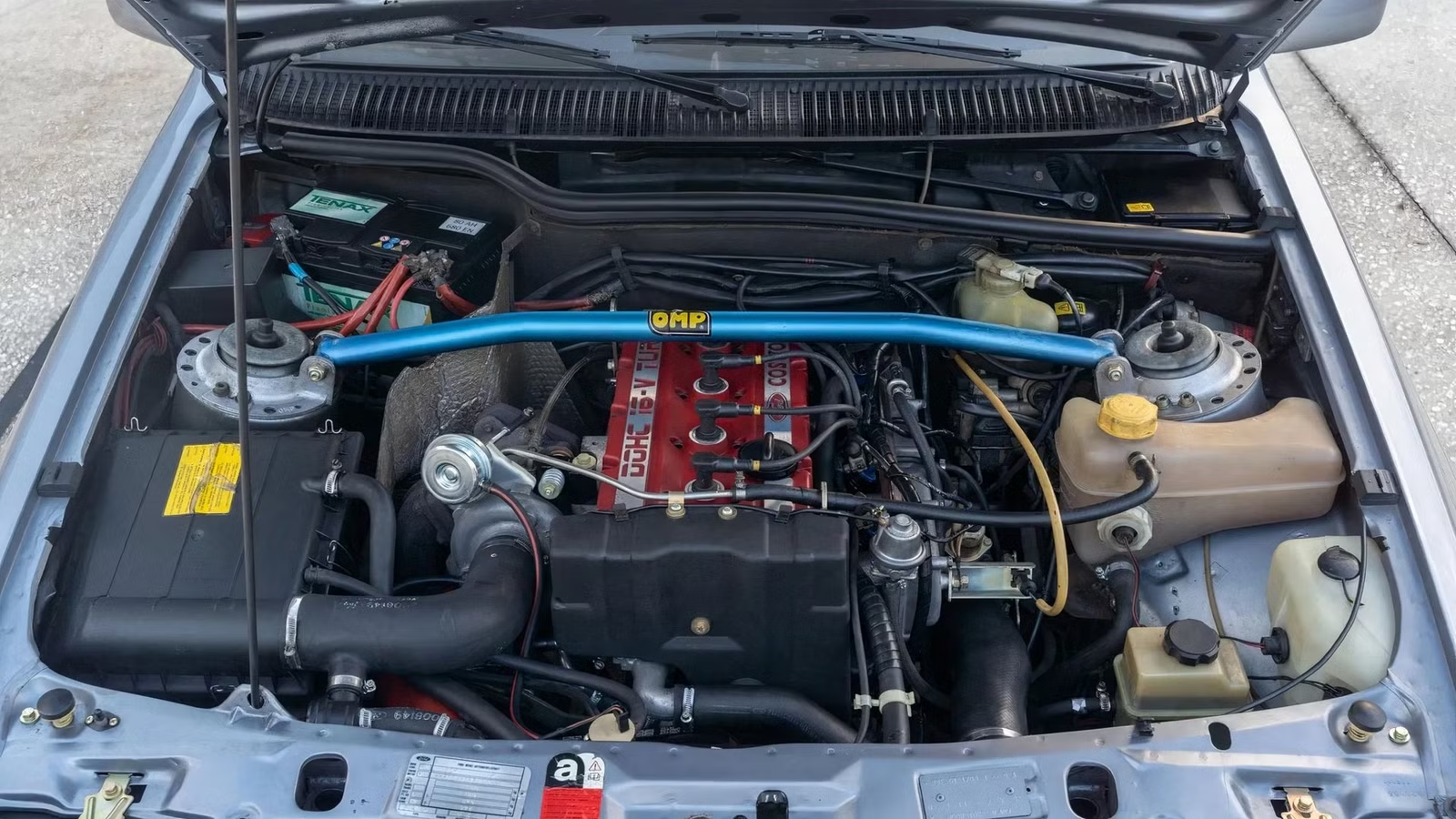
The YB is the BDA grown up and handed a turbocharger. Built on a Ford Pinto iron block with a Cosworth-designed sixteen-valve aluminum head, a Garrett T3, and an intercooler, it produced 204 hp in road specification and well beyond 550 hp in RS500 Group A race trim. The Sierra RS Cosworth that carried it dominated touring car racing across Europe, Japan, and Australia between 1987 and 1992. In road form, 204 hp in 1986 was a number that had almost no contemporary context. The three-door Sierra RS Cosworth is the one to find: 5,545 units built for Group A homologation, available only in white, black, or Moonstone Blue, and increasingly understood as the machine that defined a generation of European performance cars.
1
Mitsubishi 4G63T
244 hp, 7,000 rpm

|
Make and Model |
Power and Torque |
0-60 mph |
Top Speed |
Avg. Price |
|---|---|---|---|---|
|
Mitsubishi Lancer Evolution I (1992) |
244 hp / 228 lb-ft |
5.5 sec |
143 mph |
$20,000–$45,000 |
The 4G63T is a turbocharged 2.0-liter with a cast-iron block that engine builders have been pushing north of 700 hp for decades on the factory bottom end. The Evo I through III are the early, raw iterations before the chassis and electronics became sophisticated enough to mask what the engine was doing. In those cars, the 4G63T’s character is unfiltered. It arrived in the Lancer Evolution I in 1992 with 244 hp in JDM tune and 228 lb-ft of torque—the kind of midrange pull that makes everything off-boost feel like waiting. The early Evos are appreciating faster than later examples because the collector base understands the difference between a factory homologation car and a polished production model.
Sources: Bring a Trailer, Stellantis, Via Chill With Cars on YouTube, Car & Classic.

Related posts



Latest Post


No Comments