
8 Mid-Engine Classics That Pioneered the Supercar Formula
If you want to know how today’s supercars developed, you have to look back to the past. Specifically, you have to look back to the classic sports cars of the mid-20th century. These cars pioneered so many design and engineering elements that we still see in brand-new cars today.

What counted as the first mid-engined sports car or supercar is a bit murky, in terms of consensus. What we know for sure, though, is that these cars started appearing in the mid-1960s. After these cars appeared, things were never the same again.
8
De Tomaso Vallelunga
Year Introduced: 1964
|
Engine |
 35 autotech Transmission |
Drivetrain |
Power |
Torque |
|
1.5-liter inline-4 |
4-speed manual, 5-speed manual |
Rear-wheel drive |
104 hp |
128 lb-ft |
If you go entirely by which mid-engined sports car came to market first, the De Tomaso Vallelunga is the car that laid the groundwork for the modern supercar. Alejandro De Tomaso was incredibly forward-thinking with this model. It’s incredibly light, weighing only 1,601 lbs, and is powered by a 1.5-liter Ford engine that produces 104 hp. That small amount of power is all the Vallelunga needed to be a genuinely capable sports car.
While the Vallelunga is a fairly forgotten sports car, its engineering became very significant later on. The Vallelunga’s basic platform was used to create the De Tomaso Mangusta, which came onto the market in 1967. This kept the mid-engined, rear-wheel drive layout of the Vallelunga, but gave it a more angular body that was more in keeping with the style of the early supercars. The platform was also re-engineered to take Ford’s 289 and 302 cubic-inch V8s.
7
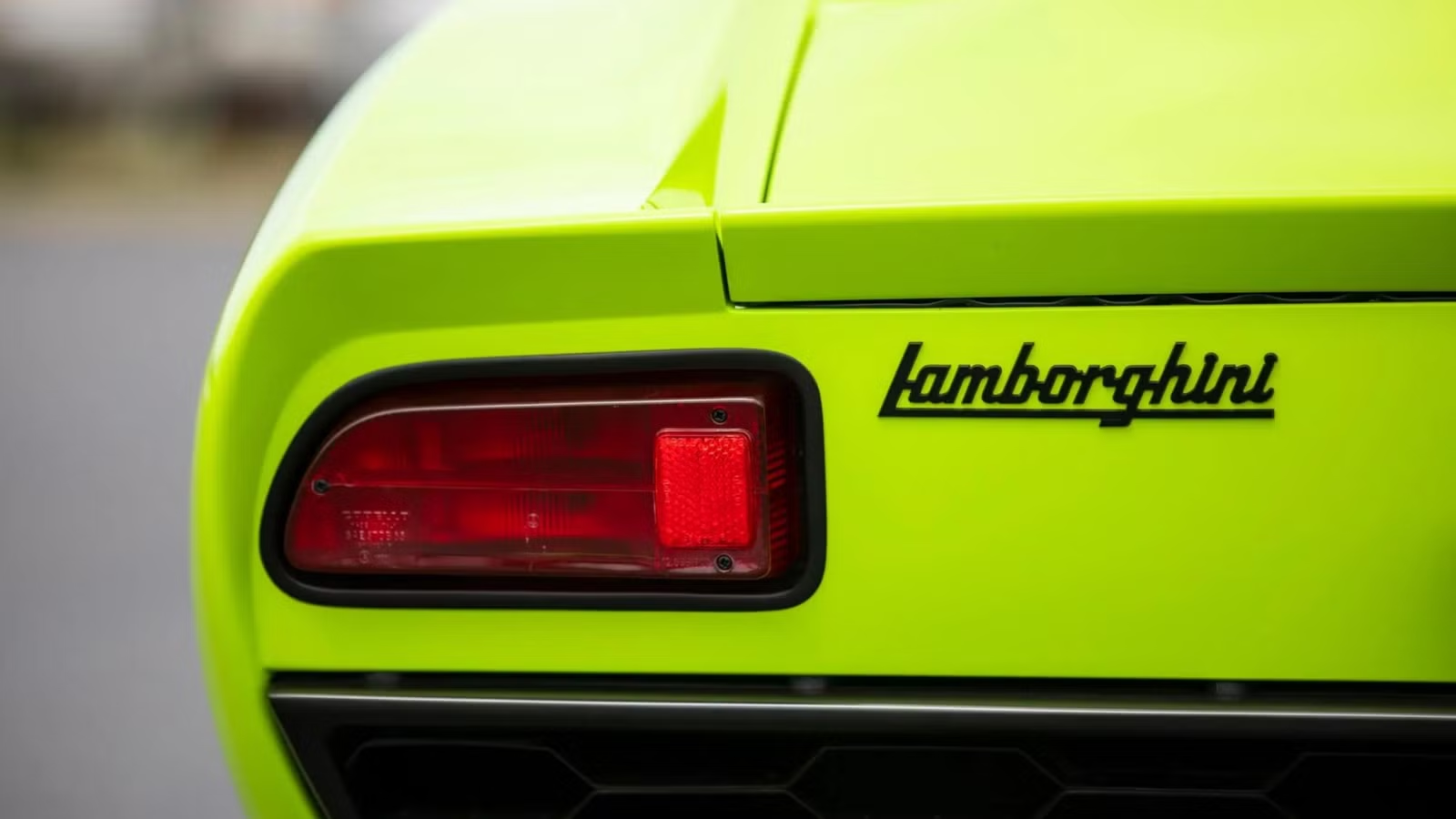
Lamborghini Miura P400
Year Introduced: 1966
|
Engine |
Transmission |
Drivetrain |
Power |
Torque |
|
3.9-liter V12 |
5-speed manual |
Rear-wheel drive |
345 hp |
262 lb-ft |
When people talk about how the supercar came to be, the Lamborghini Miura is a car they always point towards. The original P400 version was a revelation when it came onto the market in 1966. Powered by a glorious mid-mounted V12, this was a seriously fast car for its day. It’s also jaw-droppingly gorgeous, with a timeless design that’s very aerodynamic too. That design was the work of Marcello Gandini while he worked at Bertone. Combine those two elements, and it’s clear why people recognize the Miura P400 as the first mid-engined supercar.

Many people still think that the Lamborghini Miura is one of the best cars ever made. It’s really not hard to argue with that, when the P400 was not only absolutely brilliant but also one of the most important cars of all time. Without this car, the modern supercar might not have ever existed. Or, alternatively, it would have taken on a very different form than what we know.
6
Lotus Europa S1
Year Introduced: 1966
|
Engine |
Transmission |
Drivetrain |
Power |
Torque |
|
1.5-liter inline-4 |
4-speed manual |
Rear-wheel drive |
82 hp |
79 lb-ft |
The Lamborghini Miura may have pioneered the exotic, mid-engined European supercar. Colin Chapman’s Lotus Europa S1, however, pioneered the more simplified and lightweight British approach. There’s some debate as to whether Colin Chapman or Alejandro De Tomaso came up with the idea of a lightweight, mid-engined sports car first. What’s not debatable, though, is how much of an impact the Lotus Europa S1 had on how high-performance cars developed. This breadvan-style car only weighs around 1,350 lbs, thanks to a lot of weight-saving measures. These included making the bodywork out of fiberglass placed on top of a steel chassis, fixing the seats in place (the pedal box was made adjustable instead to compensate), and doors with fixed side windows and no proper door handles. As a result, it only needed an 82 hp 1.5-liter Renault engine to achieve the performance Chapman wanted from it.
The Lotus Europa S1 might look like an ugly duckling. But, its lightweight innovations set the stage for lots of supercars that came after it. It also helped move the Lotus brand forward, giving the Hethel-based automaker a strong reputation for creating fast, lightweight sports cars that prioritized driving dynamics and enjoyment over everything else. It’s unfortunate that the name later ended up being used for a car that was a total flop.
The Fastest Car From The ‘60s That Came Equipped With A Manual Gearbox
It arrived in the middle of the golden era of muscle cars and outran them all with a V12, three pedals, and a stick.
5
Ferrari Dino 206 GT
Year Introduced: 1967

|
Engine |
Transmission |
Drivetrain |
Power |
Torque |
|
2-liter V6 |
5-speed manual |
Rear-wheel drive |
178 bhp |
138 lb-ft |
When people talk about Ferrari’s history, the original Dino 206 GT isn’t mentioned that much. A lot of Ferrari enthusiasts have seen the Dino models as not being “proper” Ferraris. But, the Dino 206 GT was actually a trailblazer when it came to the development of mid-engined sports cars and supercars. It’s compact, lightweight, and powered by a small V6 engine (also found in the Fiat Dino) that was surprisingly powerful for its time. This V6 also loved to rev, making the Dino have a fun and unique character. It was a Ferrari that introduced some firsts for the brand, too. For a start, it was the first Ferrari intended to be properly mass-produced. It was also the first Ferrari to have a direct rack-and-pinion steering system, which no doubt enhanced the driving experience.

These smaller Ferraris don’t get the fanfare that bigger and later models do. But, the original Dino 206 GT and its 246 GT successor showed that going for a smaller displacement engine in a smaller, lighter car can be a recipe for supercar success. It’s something Ferrari followed itself for later mid-engined Ferrari models, like the beloved F355.
4
Porsche 914
Year Introduced: 1969

|
Model |
Engine |
Transmission |
Drivetrain |
Power |
Torque |
|
914/4 |
1.7-liter flat-4 |
5-speed manual |
Rear-wheel drive |
79 hp |
100 lb-ft |
|
914 1.8 |
1.8-liter flat-4 |
5-speed manual |
Rear-wheel drive |
84 hp |
102 lb-ft |
|
914 2.0 SC |
2-liter flat-4 |
5-speed manual |
Rear-wheel drive |
99 hp |
118 lb-ft |
|
914/6 SC |
2-liter flat-6 |
5-speed manual |
Rear-wheel drive |
190 hp |
118 lb-ft |
The Porsche 914 is often a forgotten car in the history of the iconic German brand that made it. That’s odd in many ways, because this is the car that paved the way for Porsche’s later mid-engined models. It was the first joint venture between Porsche and Volkswagen, designed as a replacement for Porsche’s 912 and Volkswagen’s Karmann-Ghia. In addition to being the first Porsche to have an engine mounted in the middle of the car, it featured a modern unibody construction.

Like the Porsche Boxster and Cayman that appeared many years later, it was also exclusively powered by boxer engines. The 4-cylinder options were air-cooled Volkswagen units, and weren’t anything special. The 914/6, though, used a true Porsche engine—the 2-liter flat-6 from the 911T. There was also a crazy prototype called the 911/8 that used the Type 308 flat-8 racing engine! The 914/6, though, has to be the most important variant for how the mid-engined supercar developed. Without the 914/6, we wouldn’t have cars like the Porsche Cayman GT4.
3
AMC AMX/3
Year Introduced: 1970

|
Engine |
Transmission |
Drivetrain |
Power |
Torque |
|
390 cubic inch V8 |
4-speed manual, 5-speed manual |
Rear-wheel drive |
340 hp |
430 lb-ft |
The AMC AMX/3 is one of the most oddball prototypes ever made by an American automaker. This was supposed to be a mid-engined supercar that could take on the best from Europe, and AMC took the project very seriously. While it had an angular European design that was contemporary to its peers, the mechanical side of this car was very American. It’s powered by AMC’s 390 cubic-inch V8, producing 340 hp and 430 lb-ft of torque. Some of the other mechanical components were of European origin, including a chassis and suspension design developed with input from former Ferrari engineer Giotto Bizzarrini. All this meant that, if it had ever entered production, it could have easily been competitive with the European cars AMC would have positioned it against.
The AMC AMX/3 is quite possibly the first proper example of what a supercar done the American way could be like. It’s bold, brash, and its powertrain is more muscle car than supercar. That set the stage for other American supercar experiments in later years, like the Vector W8 and the Saleen S7. You could even argue that the supercar-challenging variants of the C8 Chevrolet Corvette (like the absolutely insane twin-turbocharged ZR1) can trace their way back to the AMC AMX/3!
The Most Stunning Classic Ferrari Alternative That’s Now Worth Just $10K
Would you buy this mid-engined exotic for the price of an old Ford Focus?
2
Lamborghini Urraco P250
Year Introduced: 1972
|
Engine |
Transmission |
Drivetrain |
Power |
Torque |
|
2.5-liter V8 |
5-speed manual |
Rear-wheel drive |
217 hp |
162 lb-ft |
Revealed to the public in 1970 and going on sale in 1972, the Lamborghini Urraco P250 was the first mid-engined model to come out of Sant’Agata. This car took the Miura’s mid-engined layout and scaled it down into a more approachable and affordable model. Like the Miura, it got a striking design penned by Marcello Gandini while he was a Bertone employee. In keeping with what Lamborghini wanted, Gandini designed something more practical than the Miura. It’s a 2+2 instead of a strict two-seater, although you probably wouldn’t want to carry adults in the back!
The Urraco P250 should have been a big hit. But, things didn’t work out that way. Despite that, it’s still a really important part of Lamborghini’s evolution. Without the Urraco, we wouldn’t have had the modern, smaller mid-engined Lamborghinis like the Gallardo, the Huracan, and the Temerario. Those later cars have all been integral parts of the modern supercar landscape.
1
Lancia Stratos HF
Year Introduced: 1973

|
Engine |
Transmission |
Drivetrain |
Power |
Torque |
|
2.4-liter V6 |
5-speed manual |
Rear-wheel drive |
190 hp |
166 lb-ft |
The Lancia Stratos HF has absolutely legendary status in some circles. It was designed from the ground up to absolutely dominate in rallying. The rally car actually came before the road car in its development—the road car was just a homologation special so that the Stratos HF was legal to race. While it undeniably delivered fantastic performance (as demonstrated by its rallying exploits), the real influence the Stratos had on the supercar world was its looks. Its radical wedge-shaped design was another Marcello Gandini creation, further stamping his mark on the development of how a supercar should look.

Whether you can consider the Lancia Stratos a supercar is debatable. This car fits much more closely with the rally homologation specials that have appeared over the years, like the Ford RS200. But, the Lancia Stratos HF’s crazy design was a game-changer, and absolutely influenced the way supercars look today.
5 Analog Supercars Climbing In Value Faster Than A 911
These raw, analog machines are outpacing the iconic air-cooled 911 as collectors hunt for pure driving experiences.
Sources: AMC, De Tomaso, Lamborghini, Lancia, Lotus, Porsche

Related posts




Latest Post



No Comments