
The Full-Size Oldsmobile That Quietly Kept Big-Block Torque Alive
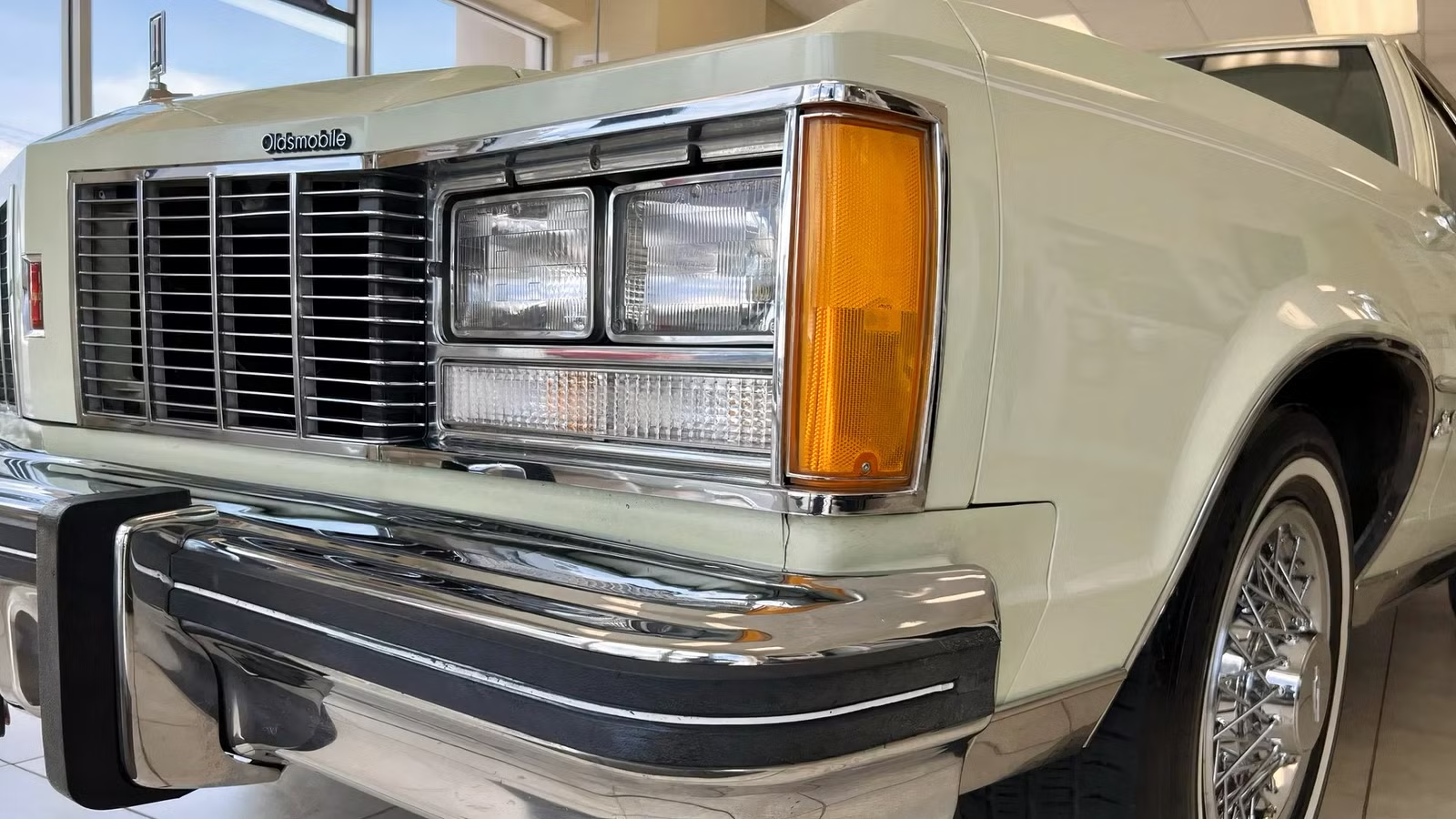
Muscle cars didn’t quietly fade away in the early ’70s. They got kneecapped by a paperwork change, a fuel switch, and an insurance industry that suddenly hated horsepower. The period press and media wrote the obituary fast, and for most of Detroit, they weren’t wrong to. But while Detroit’s flashiest nameplates got detuned into submission, one full-size family sedan just kept doing its own thing. It wasn’t chasing quarter-mile glory or magazine covers. It just hauled a family in total comfort, and happened to hide a genuine big-block under the hood that almost nobody noticed.
Where It All Began: The Shift Of 1972

The early ’70s hit the American car market with a one-two punch. Gas prices and insurance premiums both spiked, and right in the middle of that mess, automakers got forced into changing how they measured horsepower altogether. It started with fuel. In January 1970, General Motors president Ed Cole announced the company would drop compression ratios across its entire lineup so every engine could run on unleaded gasoline starting with the 1971 model year. It was a startling move at the time, and it was meant to pave the way for catalytic converters, which needed lead-free fuel to survive. The rest of Detroit followed GM’s lead within a year or two, whether they wanted to or not.
The Gross-to-Net Ratings Switch

Then came the paperwork. For decades, factories quoted gross horsepower, an engine tested bare off the car with no accessories dragging on it. Starting in 1972, the industry switched to SAE net ratings instead, tested fully dressed with the exhaust, alternator, and everything else fighting for power. The number on the window sticker fell hard that year, and nobody had even detuned anything further to make it happen.
Stack a real compression cut on top of a stricter measuring stick, and the muscle car era’s proudest numbers cratered within two or three model years. The period press and media took one look at the falling figures and wrote the genre’s obituary. They weren’t entirely wrong: insurance surcharges and shrinking compression ratios really were squeezing high-compression performance across Detroit. But they were about to miss one of the best stories the decade had to offer, because one lineup was about to prove horsepower was never the whole picture, and torque had been quietly doing the real work the entire time.

The Full-Size Sedan That Was Not Reading The Scene

Even with all that chaos in the market, GM kept one thing alive that nobody expected from a brand busy chasing comfort and quiet: a genuine big-block, still available, on a car built for family duty rather than quarter-mile bragging rights. This wasn’t a halo car. Power, torque, and 0-60 times weren’t the pitch, not even close. The pitch was a smooth, quiet ride for a family that wanted space and a plush interior, not a stoplight showdown, and the showroom presented it exactly that way.
The engine hiding under that hood was massive, well over seven liters of displacement, bigger than anything else in a normal family sedan at the time. And yet the car built around it stayed famous for exactly the opposite of muscle car theater, a soft suspension, a hushed cabin, and a ride built to float over bad pavement rather than attack it. This thing tipped the scales well past two tons before anyone even checked the big-engine box, heavier than plenty of the cars people actually picture when they hear “muscle car.”
The trim level built around this engine added leather upholstery, a vinyl-covered roof, and a deluxe steering wheel—not stripes or scoops or anything that telegraphed performance. It sat one notch above the base model in the lineup, the mid-tier trim having already been dropped by the time this story really gets going, leaving just a plain version and this dressed-up one. That’s the whole point of a sleeper. It followed the brand’s usual playbook of comfort first, and the big V8 just happened to be sitting there as an engine choice, not a statement, no scoops, no stripes, nothing at all to give the game away.
The Sedan That Hides A Rocket V8, Oldsmobile Delta 88 Royale

The car is the Oldsmobile Delta 88 Royale, riding on a 124-inch wheelbase under GM’s full-size B-body platform. Call it a land yacht and you won’t get an argument. This thing floated at cruising speeds with an entire family aboard without breaking a sweat. The Royale trim added leather upholstery, a vinyl-covered roof, and a deluxe steering wheel over the standard Delta 88—comfort and presentation, not performance, right down to the badge on the trunk lid. Standard equipment on a Royale hardtop sedan already included a Turbo-Hydramatic transmission, power front disc brakes, power steering, carpeting, and even a windshield-mounted radio antenna before anyone opened the options sheet.
The Rocket 455, By The Numbers

But the real story sits under the hood: the optional 455-cubic-inch Rocket V8, Oldsmobile’s own big-block, built in-house and shared across the brand’s full-size lineup. The 455 dated back to 1968, a stroked version of Oldsmobile’s earlier 425, keeping its 4.126-inch bore while stretching the stroke to 4.25 inches. That bore and stroke never changed for the whole 1968–76 run; only compression, carburetion, and emissions calibration did. Here’s the detail worth remembering: the 455 was always an option on the Royale, never a standalone trim or a special badge of its own.
In 1971, the standard two-barrel version was rated at 270 gross horsepower. When the industry-wide switch to net ratings landed the following year, that same engine settled in around 225 net horsepower on paper, though the actual driving experience barely changed. Oldsmobile built 142,220 Royales in 1973 alone, so this wasn’t some rare special order; it was sitting on dealer lots by the tens of thousands. A year later, the two-door coupe alone accounted for over 27,000 of them, while the increasingly rare convertible barely broke 3,700.
By 1976, the option’s final year in this generation, output had eased down to 190 net horsepower, with torque still holding at 350 lb-ft. Horsepower had fallen by nearly a third since the 1971 gross-rated figure. Torque, as it turns out, barely moved at all.
When Torque Figures Backed Up The Story

Here’s where the torque numbers do the heavy lifting. Horsepower fell from a gross-rated 280 in 1971 to a net-rated 225 through the early-to-mid ’70s, and down to 190 net by 1976, partly a real decline and partly the result of a stricter measuring stick applied partway through. Torque didn’t play by the same rules at all. The 455 held around 360 lb-ft through the early net-rated years and was still putting out 350 lb-ft in its final season. That’s the whole argument sitting right there in the numbers. Horsepower is what gets printed on a spec sheet and argued about online. Torque is what actually shoves two tons of Detroit steel past a slow-moving truck without the engine breaking a sweat, and that’s the number that stayed put here. One figure tells a story of decline. The other tells a story of a big-block that barely noticed anything had changed.
Paying More For Less, On Paper

The contrast sharpens further against the sticker price. A Royale ran $4,150 to $4,450 in 1973, $4,060 to $4,490 in 1974, and $4,500 to $5,210 by 1975, a real jump inside just two years. By 1975, buyers were paying noticeably more for a car making less peak power on paper than it had in 1971, and torque still hadn’t budged. Nobody was buying this car for a horsepower number anyway.
That stability is what kept the Royale genuinely capable at speed, effortless passing power, not quarter-mile bragging rights. This was never a quick car in the drag-strip sense, and it never tried to be. It was a fast-highway-car story from day one, and the torque figures back that up better than any horsepower rating could. The 455 stayed on the Royale’s order sheet all the way through 1976, its final model year in this generation.
The Last Full-Size Big-Block Standing Before GM Downsized Everything

GM downsized the entire B-body lineup for 1977, ending this generation and, with it, the Delta 88’s 455 option for good. The redesigned car dropped to a 116-inch wheelbase from 124 inches and shed nearly 900 lbs. The Rocket V8’s old job as standard equipment went to a Buick-sourced V6, with Oldsmobile’s own smaller V8s continuing as options for years afterward. The 455-equipped Royale never got the send-off a true muscle car receives: no farewell edition, no clean cutoff people mark on a calendar. It just quietly stopped being an option one model year and never came back, the same understated way it had done everything else.
The Verdict On The Family Car With A V8

One more footnote before this generation closed out. For 1974 through 1976, GM briefly sold a factory airbag option on its full-size cars, Oldsmobile’s Eighty-Eight included—decades before airbags were ever mandated—a genuine attempt to get ahead of federal safety rules everyone knew were coming. Barely anyone ordered it, and GM pulled the option once the downsized cars arrived, but it’s a reminder that this whole generation was quietly ahead of the curve in more ways than one.
Surviving examples still circulate in the collector market today, and they sell for real-world money rather than muscle-car-icon money. Recent auction data puts the average sale for these model years in the $11,000 to $15,000 range depending on year and condition, and the low end goes a lot lower than that. This was never a car chasing quarter-mile glory or a magazine cover, and it never pretended otherwise. Everyone was staring at the horsepower column while this thing quietly outlasted the muscle car era on torque alone. Turns out the number that mattered most was the one nobody was watching.
Sources: Mecum, Bring a Trailer, Classic.com, Hagerty

Related posts

Latest Post


No Comments