
The 1969 Pontiac Convertible That Became Muscle Car’s Seven-Figure Phantom
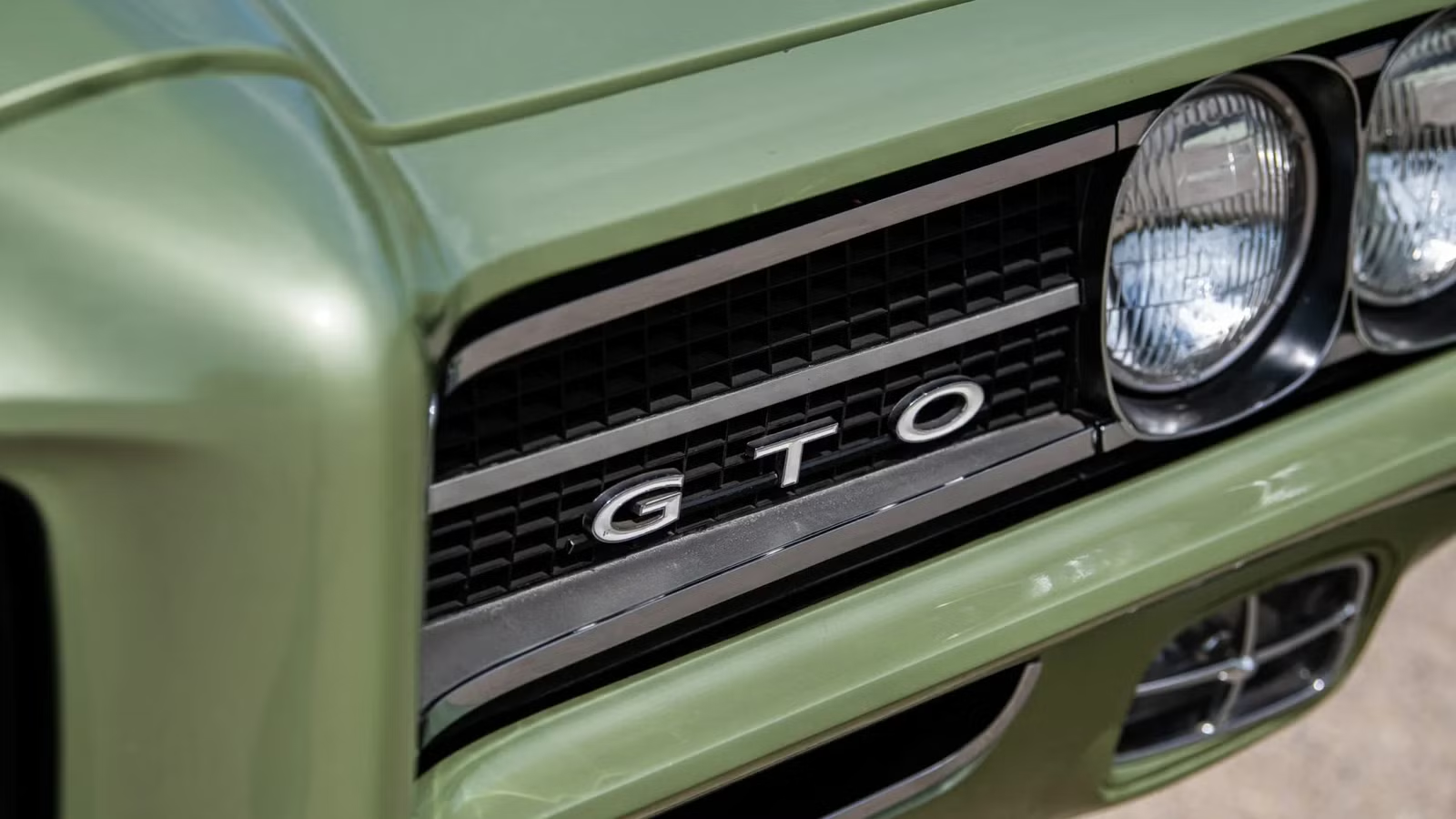
There are muscle cars that became famous because manufacturers intended them to. Then there are the ones that history created by accident. Somewhere during the 1969 model year, a handful of buyers walked into Pontiac dealerships and assembled an unusually specific combination of factory options. At the time, it was simply another order. Decades later, it would become one of the most coveted specifications in the collector world.

The irony is that nothing about the order sheet suggested future exclusivity. The performance package wasn’t marketed as a limited edition, the engine’s official output barely hinted at its true capability, and the body style itself was already losing favor with American buyers. The rarity that now commands six- and seven-figure auction prices wasn’t engineered in Pontiac’s studios—it emerged from customers making ordinary purchasing decisions during the final peak of the muscle-car era.
Three Checkboxes Created Pontiac’s Ultimate Collector Car
By the late 1960s, Detroit had turned the muscle-car order form into a performance menu. Buyers could choose everything from axle ratios and close-ratio gearboxes to heavy-duty cooling systems and competition-inspired engines. The rarest cars often weren’t special editions announced with fanfare—they were ordinary production models built in combinations that almost nobody selected.

Timing amplified those decisions. Insurance companies had begun treating horsepower as a financial liability, while emissions regulations were reshaping engine development across Detroit. Manufacturers still offered formidable V8s, but the era of unchecked performance was approaching its end. Buyers increasingly had to justify expensive performance options that might soon disappear.
That environment rewarded practicality over extravagance. Hardtops outsold convertibles by a growing margin, especially among performance buyers who valued lower prices, greater structural rigidity, and cleaner rooflines. Without intending to, the market was laying the foundation for one of Pontiac’s rarest factory specifications.
Pontiac Built A Street Racer Few Buyers Ordered

One of Pontiac’s answers to this changing landscape arrived midway through the 1969 model year. What began as a value-oriented performance package quickly became the division’s halo offering, combining distinctive styling with the brand’s most serious factory hardware. It strengthened Pontiac’s performance image without requiring the company to engineer an entirely new model.
Its greatest asset wasn’t the colorful graphics or rear spoiler that attracted showroom attention. Buried within the options list was a competition-bred engine package developed from Pontiac’s high-performance program. It represented the closest thing buyers could order to a factory race engine while remaining fully street legal.
Few customers paired that engine with an open-top body. Convertibles were already becoming niche purchases, and adding every available performance option only pushed the sticker price higher. Those ordinary market forces—not deliberate production limits—would ultimately determine which specification enthusiasts would spend decades chasing.
Meet The 1969 Pontiac GTO Judge Ram Air IV Convertible

The mystery ended with three selections on Pontiac’s order sheet: the Judge package, the Ram Air IV engine, and a convertible body. Together, they created the 1969 Pontiac GTO Judge Ram Air IV Convertible—arguably the most desirable factory specification Pontiac offered during the muscle-car era.
1969 Pontiac GTO Judge Ram Air IV Convertible Key Specifications

|
Engine |
Power |
Torque |
Transmission |
Drivetrain |
|
400-cu-in (6.6-liter) Ram Air IV V8 |
370 hp (gross) |
445 lb-ft (gross) |
Close-ratio 4-speed manual |
Rear-wheel drive |
Across the 1969 model year, Pontiac built 108 GTO Judge convertibles spanning all available engine combinations. Exactly how many received the Ram Air IV remains one of the most debated questions in Pontiac history. Sports Car Market and several long-established Pontiac registries identify five examples, all equipped with four-speed manual transmissions. Other historians, including Hagerty, caution that factory VIN data and surviving production records cannot conclusively isolate every Judge-specific Ram Air IV convertible from broader Ram Air IV GTO production. Rather than weakening the story, that documentation gap has become part of the car’s enduring mystique.
What isn’t disputed is the specification’s significance. It combined Pontiac’s flagship performance package with its most competition-focused production engine at a time when buyers were already abandoning high-performance convertibles. Instead of creating an intentionally exclusive model, Pontiac simply allowed customers to build one.
The Judge itself had been conceived as a response to affordable muscle cars like Plymouth’s Road Runner, but this particular configuration moved far beyond that original mission. It transformed a marketing exercise into an engineering showcase, pairing a flamboyant appearance package with an engine whose capabilities Pontiac could scarcely advertise in full.
The result wasn’t merely a rare GTO. It became the point where three independent choices—body style, performance package, and engine—collided to create the configuration collectors now regard as Pontiac’s ultimate factory unicorn.
The Street-Legal Race Engine Pontiac Couldn’t Fully Advertise

The Judge package attracted buyers into showrooms, but the Ram Air IV justified its place on the order form. Although Pontiac officially rated the 400-cubic-inch V8 at 370 horsepower and 445 lb-ft of torque, those figures reflected more than engineering. By 1969, General Motors had little incentive to advertise every available horsepower as insurance companies increasingly targeted high-output muscle cars and regulators began scrutinizing performance claims.
The Ram Air IV earned its reputation through hardware rather than marketing. Round-port No. 722 cylinder heads dramatically improved airflow compared with the Ram Air III, while an aluminum intake manifold reduced weight and complemented the engine’s larger ports. Pontiac also specified the aggressive 041 camshaft, giving the engine a noticeably stronger appetite for higher engine speeds at the expense of some low-RPM civility. It wasn’t designed to feel effortless around town—it was engineered to breathe where most street engines began to fade.
That combination led many enthusiasts and engine builders to conclude the Ram Air IV produced considerably more power than Pontiac admitted. Estimates of 400 to 450 horsepower have circulated within the hobby for decades, although Pontiac never published figures beyond its official rating. What could be measured, however, was performance. Car and Driver recorded a 13.7-second quarter-mile at 103.6 mph, placing the Ram Air IV Judge among the quickest American production cars tested during the muscle-car era.
Viewed through today’s lens, the Ram Air IV represented the final expression of Pontiac’s first-generation high-performance philosophy. Within a few years, lower compression ratios, tightening emissions standards, and the industry’s transition to SAE net horsepower ratings would fundamentally change how American performance engines were engineered—and perceived.
The Paper Trail Is Rarer Than The Car

The Judge Ram Air IV convertible owes as much of its reputation to documentation as it does to engineering. Authenticating one requires considerably more than matching a VIN to a production year because Pontiac’s vehicle identification numbers do not encode every factory-installed option. Instead, collectors rely on original invoices, build sheets, Protect-O-Plate records and documentation supplied through Pontiac Historic Services (PHS) to establish how a particular car left the assembly line.
That paperwork also explains why production totals remain one of the most debated topics surrounding the model. Several Pontiac registries identify five Ram Air IV Judge convertibles built for 1969. Other historians urge caution, noting that while overall Ram Air IV GTO convertible production is better documented, surviving factory records cannot definitively isolate every Judge-equipped example. The disagreement stems less from conflicting research than from the limitations of the original documentation.
For collectors, those uncertainties elevate rather than diminish the importance of provenance. A documented factory-built Judge Ram Air IV convertible carries a premium because its originality can be traced through paperwork instead of assumptions. In a market where tribute cars and converted GTOs exist, documentation has become the dividing line between a valuable restoration and one of Pontiac’s most desirable production cars.
The irony is that the paper trail can now be harder to replace than many mechanical components. Engines can be rebuilt, sheet metal can be repaired and interiors can be restored, but factory documentation remains irreplaceable. For this Pontiac, authenticity begins in the filing cabinet before it reaches the garage.
When Documentation Became Worth More Than Horsepower

For much of the 1970s and 1980s, the Judge Ram Air IV convertible occupied a niche within the collector community. The broader market appreciated the GTO name, but few buyers distinguished between individual engine packages or understood how unusual certain option combinations had become. As muscle cars matured from used performance machines into collectible automobiles, attention shifted toward documented factory specifications.
One of the clearest indicators came in 2010, when a documented triple-black 1969 Judge Ram Air IV convertible sold for $682,000 at public auction. The result highlighted the premium collectors were willing to pay for a verified example of this specific configuration rather than for a restored Judge alone.
The wider Ram Air IV market reinforced the trend. Public sales of Ram Air IV-equipped GTOs have reached $914,703, illustrating how Pontiac’s most competition-focused production engine has become one of the defining value drivers within the marque. While not every Ram Air IV GTO approaches that figure, the result establishes the valuation ceiling that exceptional, thoroughly documented examples can achieve.
Those prices reflect more than rarity. They reward an unusual convergence of engineering significance, original documentation and historical circumstances. Plenty of muscle cars are scarce because manufacturers intentionally limited production. This Pontiac became valuable because very few customers unknowingly assembled the same combination of factory options.
Pontiac Never Intended To Build Its Most Valuable Judge

Pontiac never announced the Judge Ram Air IV convertible as a limited-production flagship. It wasn’t developed as a homologation special, nor was it marketed as the ultimate expression of the GTO. The company simply gave buyers the freedom to combine its boldest appearance package, its most advanced production V8 and an increasingly unpopular body style in the same order form.
Half a century later, those choices have become the car’s defining legacy. The Judge package gave it presence. The Ram Air IV gave it credibility. The convertible body gave it scarcity. None of those elements was extraordinary in isolation. Together, they produced a specification that even Pontiac could not have predicted would become one of the hobby’s most coveted prizes.
Sources: GM Heritage Center, PHS Automotive Services, Hagerty, and The Classic Valuer

Related posts






Latest Post


No Comments