
Porsche Is Ending Gas-Powered Macan Production This Month—Here’s What Buyers Lose
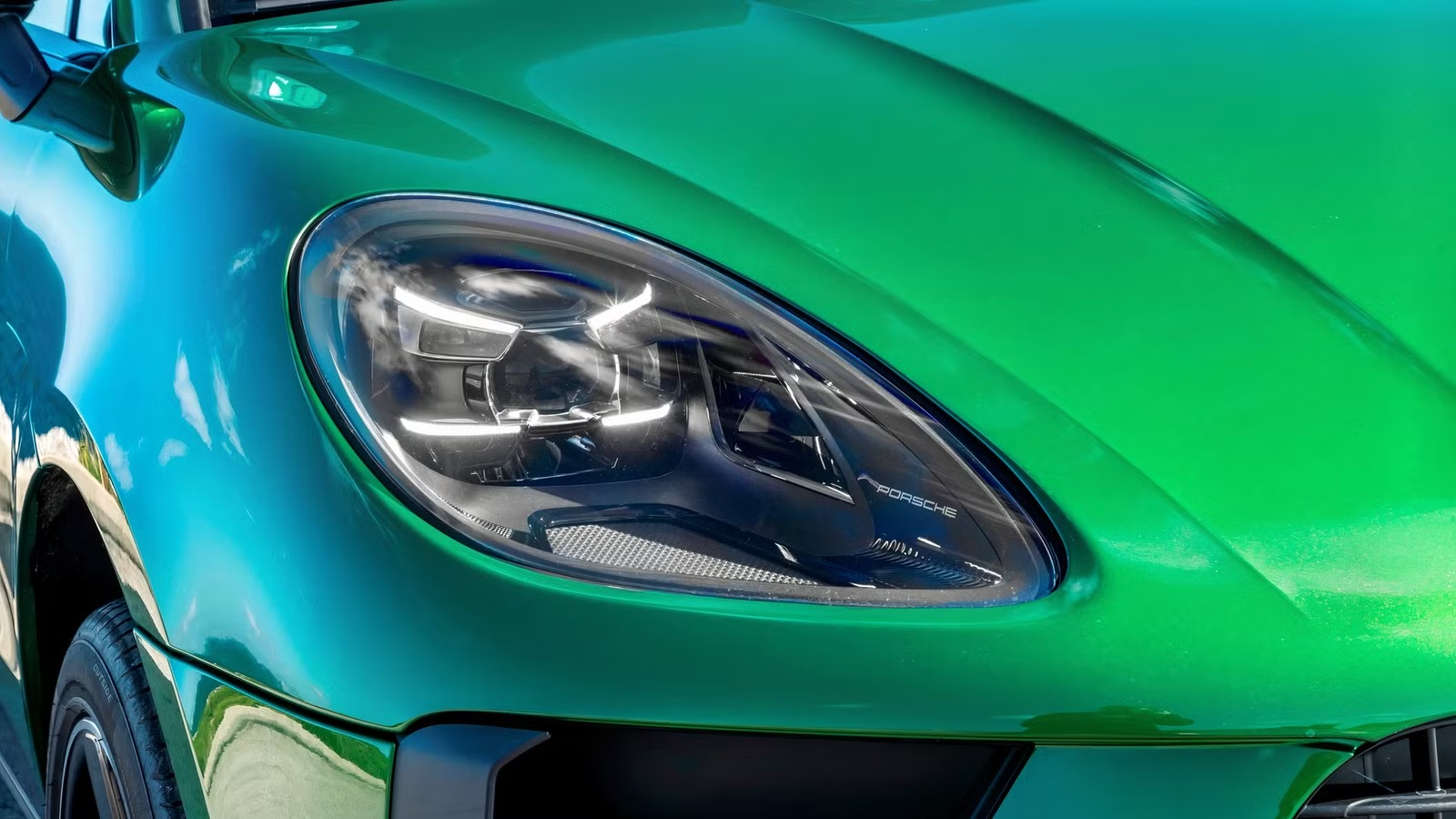
Porsche is shutting down gasoline Macan production by the end of July 2026, and that deadline is now weeks away. Whatever new gas Macans remain on dealer lots are, effectively, the last ones that will ever exist—once they’re gone, buyers who want a combustion-engine entry-level Porsche SUV will have nowhere to turn.

The shift marks a hard pivot for a nameplate that spent over a decade as Porsche’s most accessible and best-selling model. Going forward, the Macan is electric-only. For shoppers who’ve been on the fence, the window to buy a new gas Macan is closing fast—and it’s worth understanding exactly what’s at stake before it shuts entirely.
What The Gas Macan Offered—And Why It Connected
The gasoline Macan built its reputation on a straightforward formula: genuine Porsche driving character in a compact SUV package priced well below the Cayenne. The second-generation model, which ran from the 2022 model year through this final production run, was offered with a 2.0-liter turbocharged four-cylinder producing 261 horsepower in the base Macan, and a 2.9-liter twin-turbocharged V6 making 375 horsepower in the Macan GTS. Both paired with a seven-speed PDK dual-clutch transmission and standard all-wheel drive.

Base pricing started around $60,000, with the GTS climbing toward $85,000 before options. That spread put the gas Macan in direct competition with the BMW X3 M40i and Mercedes-Benz GLC 300—but Porsche’s chassis tuning gave it a sharper, more driver-focused feel than either. The steering was communicative, the ride firm without being punishing, and the PDK shifts were quick enough to remind you this was still a Porsche underneath the crossover body.
Why Porsche Is Pulling The Plug Now

Porsche’s decision to end combustion Macan production isn’t a surprise—the electric Macan launched in 2024, and the two generations have been sold side by side in most markets since then. Ending the gas line now consolidates the nameplate under a single powertrain and lets Porsche focus resources on scaling EV production. The move also aligns with broader European regulatory pressure pushing automakers toward electrification timelines.
The timing is notable, though. Porsche is making this cut while combustion demand remains real. The gas Macan has consistently outsold the electric version in the United States, where range anxiety and charging infrastructure concerns still shape buyer decisions. Ending production now is a strategic bet that the EV version can carry the nameplate—not a response to flagging demand for the combustion car.
The Electric Macan: What It Offers, And What It Doesn’t
The electric Macan is a genuinely capable vehicle, and on paper it closes several gaps. The Macan 4 produces 402 horsepower and reaches 60 mph in 5.1 seconds; the Macan Turbo pushes 630 horsepower and hits 60 in 3.1 seconds—significantly quicker than any gas version. The EPA-rated range runs between 288 and 308 miles depending on trim. Pricing starts around $75,000 for the Macan 4, rising to roughly $106,000 for the Turbo.
What the electric Macan doesn’t replicate is the entry price point. The gas Macan’s ~$60,000 starting MSRP made it Porsche’s most attainable new vehicle; the electric version’s floor is $15,000 higher. Buyers also give up the familiar combustion experience — the engine note, the refueling simplicity, and the range flexibility on long road trips without planned charging stops. For some buyers, those tradeoffs are fine. For others, they’re the whole reason to act now.
What This Means For Shoppers Right Now

If you want a new gas Macan, the inventory on dealer lots today is it. There will be no 2027 gas model and no special final edition announced for later in the year. Production ends this month, and once remaining stock sells through, the new-car option is gone.
On the used market, the calculus is more nuanced. A closing production run often supports used values in the near term—limited new supply tends to keep certified pre-owned prices firm. Longer term, as the EV version becomes the default Macan and combustion cars age, values will follow the usual depreciation curve. The GTS, as the highest-performance gas variant, is the trim most likely to hold value among collectors and enthusiasts. For buyers who simply want a well-priced entry into the Porsche SUV lineup, a lightly used 2024 or 2025 gas Macan may become the most practical path once new inventory dries up.
The gasoline Macan’s run lasted just over 12 years, and for most of that time it was the car that brought more buyers into Porsche showrooms than any other model. Whether the electric version can sustain that role at a higher price point remains an open question. For now, the more immediate question is simpler: if a combustion Macan was on your list, the clock has essentially run out.

Related posts






Latest Post


No Comments