
The 1969 Chevy Sleeper Its Own Builder Called ‘Lethal’
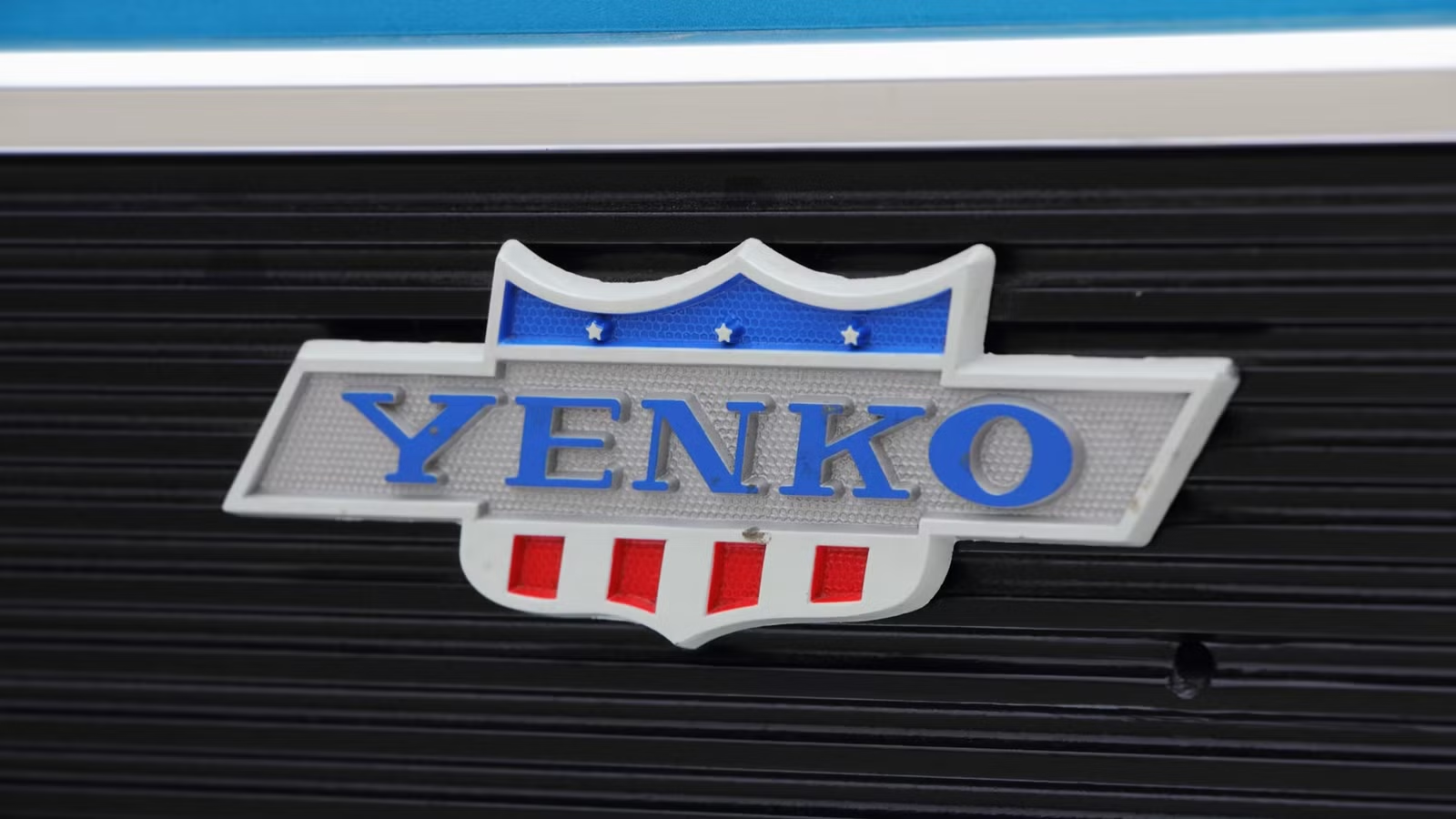
One Chevrolet dealership owner knew that he was building a car that was simply too intense for the street. However, it still entered production to prove the brand’s drag racing dominance during the late 1960s muscle car wars. It was risky at the time, as General Motors had strict corporate policies against building high-performance race cars.

But sometimes legends are created by breaking the rules. To get around racing bans, this car was hand-modified with an engine swap. The car’s own builder called it a lethal vehicle that shouldn’t be built. But it was still unleashed on the streets in small numbers as its own creator warned against it.
Then the car ran into more trouble as it was targeted by high insurance premiums and faced pressure under the Clean Air Act. Only a handful of models survive today, as the drag strip king was often destroyed due to its intense power-to-weight ratio despite looking like a humble, average car. Now its legacy lives on as a rare, historic rebel.
Dealers Wanted To Dominate The Drag Strip

In the 1960s, General Motors ruled about half of the automotive market in America, making it a target of the United States Justice Department. As a result, executives feared that owning the racetrack would attract attention from federal regulators that could break up the corporation. So, the automaker implemented strict anti-racing policies to distance itself from the “Win on Sunday, Sell on Monday” muscle car era and war.
General Motors prohibited intermediate cars from leaving the factory with engines displacing more than 400 cubic inches. This would avoid internal competition with the Corvette and help the automaker’s image. Increasing speed and power were drawing negative attention from safety advocates and insurance regulators.
But dealerships and builders still wanted to prove that Chevrolet could outrace drag-strip rivals like the Ford Mustang Boss 429 or the Dodge Charger Daytona. So, they exploited a few loopholes to build a true monster. For example, cars left the factory with standard engines, then had them replaced by hand at dealerships.
The 1969 Yenko SC 427 Nova Bypassed Factory Limits

The standard 1969 Chevy Yenko engine is an L78 396ci (6.5-liter) V8 unit that delivers 375 horsepower and 415 lb-ft of torque. It helped the car accelerate from 0 to 60 mph in about 6.5 seconds and cover a quarter mile in roughly 14.1 seconds. It features a top speed of about 143 miles per hour, but it wasn’t going to cut it on the track.
Don Yenko upgraded this car by ordering 396 models and swapping their engines for the L72 427ci (7.0-liter) big-block V8 engine. It was borrowed from the Corvette and features 425 to 450 hp and 460 lb-ft of torque. This helped the SC 427 Nova accelerate from 0 to 60 mph in around 4.1 to 5.1 seconds. By placing this engine in an economy body and sticking with a family car exterior, this car quickly gained ultimate sleeper status.
This muscle car completes a quarter mile in about 11.0 to 13.5 seconds. The exact time varies based on the traction of period-correct tires and driver experience. Also, it features a top speed of 120 mph. In most Novas, the engine is paired with a Muncie M21 four-speed manual transmission, but at least one model with an automatic transmission is believed to exist.
|
Car |
Engine |
HP |
Torque |
0-60 MPH |
|
1969 Chevy Yenko |
L78 396 ci (6.5-liter) V8 |
375 |
415 LB-FT |
6.5 seconds |
|
1969 Chevy Yenko SC 427 Nova |
L27 427 ci (7.0-liter) V8 |
425 – 450 |
460 LB-FT |
4.1 seconds |
It has a 12-bolt rear axle with a 4.10:1 gear ratio complete with Posi-traction and the F41 suspension package. The package includes heavy-duty rear leaf springs and front coil springs. It also gained a heavy-duty cooling system to prevent the 427 engine from overheating during daily driving.
But The 1969 Yenko SC 427 Nova Faced Weak Sales

Unfortunately, the 1969 Chevy Yenko SC 427 Nova didn’t have a lot of demand as it was too powerful for daily driving and lacked creature comforts. It was stripped down to reduce weight and was notably bare-bones, with black vinyl bench seats, rubber flooring, and a plain two-spoke factory steering wheel.
It had a dangerously fast acceleration that Chevrolet found to be potentially uncontrollable for daily driving. Don Yenko even admitted that the car was dangerous and should have never been made. He described it as “a beast most lethal” and “the wildest thing we ever did” due to the excessive horsepower stuffed into a lightweight chassis.
Because the SC 427 Yenko Nova has a short wheelbase, it was unable to safely handle its power. It was built for straight-line drag racing. Its unbalanced handling only fueled its dangerous reputation. Plus, front disc brakes and 1960s tire technology couldn’t handle the potent force under the hood. On top of the dangers, the car was incredibly expensive at the time, with an MSRP of just under $4,000.
Only A Handful Of Models Were Built, And Even Fewer Survive

Only about 37 or 38 1969 Chevy Yenko SC 427 Nova models were ever made. Its high price tag and dangerous reputation killed its demand. Plus, it was targeted by high insurance premiums as a liability nightmare. Insurance companies either heavily penalized the car or completely refused to cover it.
Then the Yenko 427 Nova faced pressure under the Clean Air Act. Due to increasing air quality regulations, building insanely powerful, un-smogged, high-emissions big-blocks was nearly impossible. Many sought-after high-performance muscle car engines were choked down at this time or simply discontinued.
Now, automotive historians and registry estimates believe that only seven to 10 models may still survive today. Because these cars have a lightweight chassis that could not handle their extremely powerful engines, many models were destroyed on the track. If models didn’t get pushed beyond their limits on the track, then they were often totaled in wrecks.
Collectors Pay Record Prices For The 1969 Yenko SC427 Nova

Chevrolet fans would love to own a surviving 1969 Yenko SC427 Nova. How could one ignore such a rare sleeper car? It is a true street weapon with a rebellious history. Don Yenko knew he was building a dangerous monster, but that didn’t stop him until rising insurance premiums and emission standards dropped the hammer.
Typically, models found in fair condition sell for about $248,000 to over $300,000. Examples in good condition fetch around $316,000 to $390,000. Then models in excellent condition surpass $391,000. Models in pristine, show-quality condition often sell for over $470,000, but recently one 1969 SC427 Nova broke records.
Mecum Auctions shares that a 1969 Chevrolet Yenko SC427 Nova sold for $852,500 on January 17, 2026. These forbidden sleeper builds are getting closer and closer to surpassing the one-million-dollar mark. However, these cars usually only cross the auction block once every few years, so it could be a while before another one comes up for sale.
Source: Fuel Curve, Mecum

Related posts


Latest Post


No Comments