
The Cheapest Way To Own The Engine That Powered The Lotus Elise
Yamaha is known for collaborating with a number of manufacturers on engine development over the years. One example is the 4.4-liter V8 engine fitted to the first-generation Volvo XC90. If we think about high-revving Japanese engines from the late ’90s and early 2000s, we often think about cars from Honda, such as the S2000 roadster. However, Toyota developed the legendary 2ZZ-GE engine in collaboration with Yamaha, which featured Toyota’s well-known VVTL-i system (variable valve timing and lift intelligent).

This engine would find its way into the Lotus Elise and Exige at the time, and most notably into another, currently very affordable, coupe from Toyota.
Yamaha Helped Create One Of Toyota’s Greatest Four Cylinders
A number of engineering features made this a truly special engine, especially for enthusiasts. After 6,000 rpm, the camshaft offers a more aggressive and high-lift profile. The result is improved air flow, and a true increase in the rate of engine speed as it screams to the redline at 7,800 rpm.

In keeping the weight of the engine low, an aluminum die-cast block was used as well as metal matrix composite (MMC) for the cylinder walls. It further used a forged steel crankshaft, forged connecting rods, and a high compression ratio of 11.5:1. It is evident that when two engineering giants work together on a product, the results can be quite enticing.
Everything Changes Once The Needle Passes 6,000 RPM

The high-lift camshaft profile offered complex rocker arms and the necessary dual-profile camshaft lobes. The step-up in performance that can be felt at 6,000 to 6,200 rpm is the result of oil pressure activating a mechanism; this in turn forces the rocker arm to follow a larger high-lift cam lobe. This results in better air flow, and improved performance.
The result is a direct competitor for Honda’s VTEC system, as Toyota (and Lotus) fans could now brag about having the same effect from behind the wheel of these sports coupes.
The Same Engine Family Powered The Lotus Elise

|
Displacement |
Power |
Torque |
|
1.8 Liters |
189 HP |
133 LB-FT |
Lotus’s first Elise used the K-Series engine from Rover for its lightweight sports car; however, soon thereafter, in 2004, Toyota shared the 2ZZ-GE with Lotus. There are a number of reasons for this decision. Weight has always been instrumental to Lotus’s performance, and the 2ZZ-GE was a lightweight engine that still delivered good outputs of 189 hp in the Lotus Elise 111R. The result is an excellent power-to-weight ratio for these cars.
Offering peak power of 189 hp at 7,800 rpm, it gave the Lotus driver a race-inspired experience from behind the wheel, while the fuel cut-off was set at a high 8,500 rpm. Needless to say, Lotus also needed a reliable engine, as the Elise and Exige were both road cars and track cars that owners wanted to be able to enjoy on circuit days.
Keep in mind, the engine was not only used in its naturally aspirated form, but was also fitted with a supercharger to do duty in the Lotus Exige S and the Elise SC.
The Celica GT-S Was More Than Just Its Engine

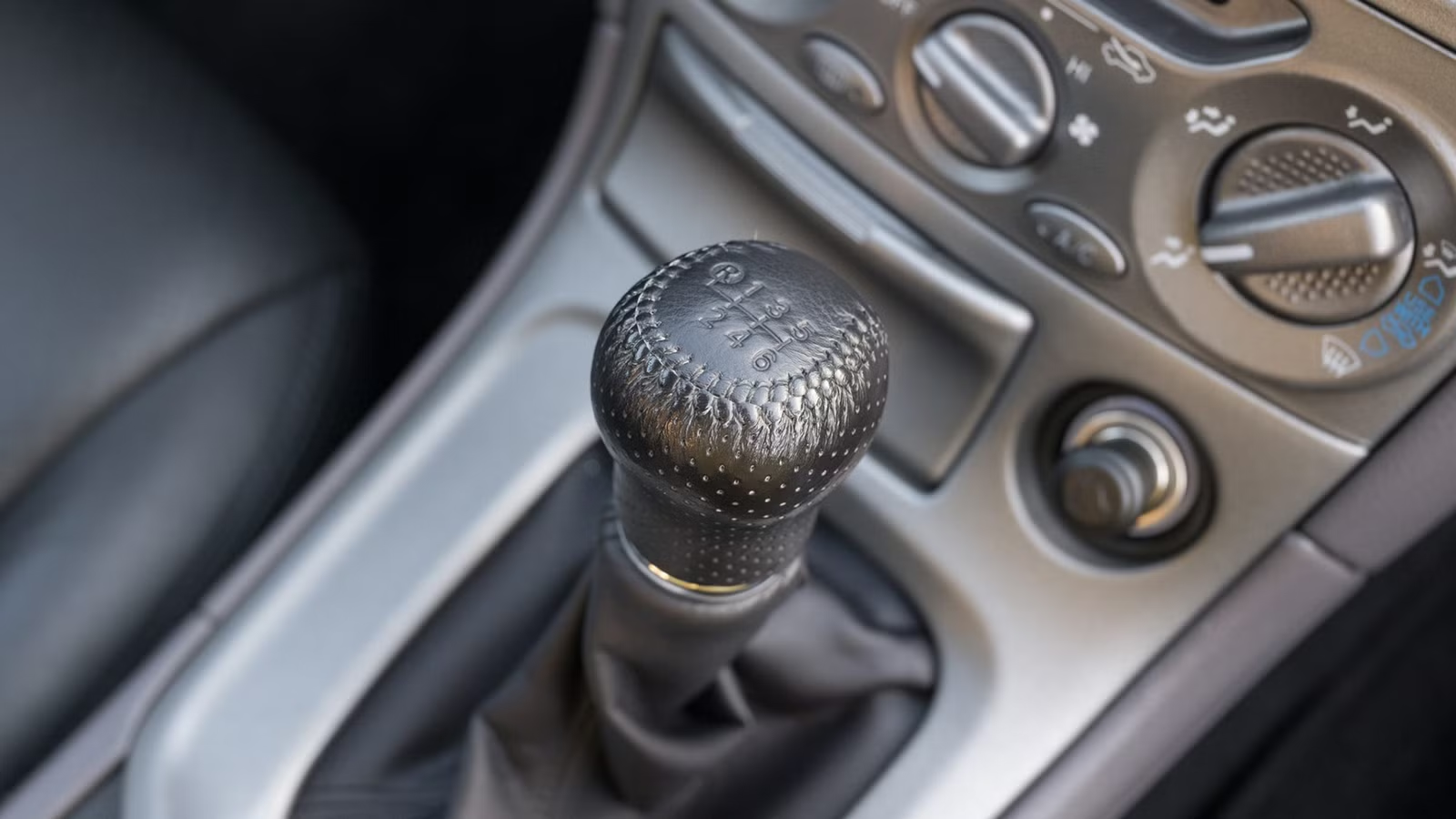
The original Celica can trace its roots back to 1970, but by the time the seventh generation was launched in 1999, drivers were in for a treat. Apart from receiving the 1.8-liter VVTL-i that would eventually be shared with Lotus, the Celica also featured a six-speed manual gearbox, MacPherson suspension in the front, and a double-wishbone setup at the rear.
Combined with a proper braking system offering discs all around and ABS with EBD, the overall package the Celica offered with the high-revving 2ZZ-GE engine made this one of Toyota’s standout sports coupes. Keep in mind that the summer of 2001 saw the release of The Fast and the Furious movie series, followed by 2 Fast 2 Furious in 2003. The films helped fuel enthusiasm for Japanese performance cars, and the Celica GT-S benefited from that growing interest among younger enthusiasts.
It Was Quicker Than Most People Remember

Although the Elise and Exige were understandably lighter than the Celica GT-S, the latter still offered exciting performance. In standard trim it offered 180 hp at 7,600 rpm and 130 lb-ft at a still high 6,800 rpm. The redline of 7,800 rpm (or a rev limit of 8,300 rpm depending on the model year) invited drivers to keep the engine in the powerband. Toyota applied the same lightweight philosophy to the rest of the car. The GT-S tipped the scales at only 2,502 lbs (curb weight). The result was a 0-60 mph time of 6.6 seconds and a top speed of 129 mph.
To put that in perspective, the Acura Integra GS-R (MK III) from a few years earlier also featured a 1.8-liter engine, delivering 170 hp at 7,600 rpm and 128 lb-ft at 6,200 rpm in a body weighing 2,667 lbs. Independent tests done at the time achieved 0-60 mph times of 7.0 seconds, while top speed is said to be 135 mph.
Reliability Makes It Even More Appealing

Toyota is synonymous with reliability, and if properly maintained, that is also the case with the 2ZZ-GE, despite its high-revving nature. Keep in mind that some examples are now approaching their 26th year since leaving the factory, so due diligence should be done when a possible acquisition is on the table.
Check if the VVTL-i system is working and that you can feel the engine’s response change after 6,000 rpm. The engine is fitted with a timing chain and not a belt. Although this part is very durable, the timing chain tensioner gasket is known to develop oil leaks. Thankfully, it is an inexpensive repair. Consider all the perishables around the car, from the coolant pipes to the suspension system and check if any of these will need replacement in the future.
Enthusiasts Still Have Not Driven Prices Into The Stratosphere

Some Japanese performance cars have received a lot of attention in the past decades. Cars like the Honda S2000 are now some of the most collectible Japanese cars from the early 2000s. However, thankfully, the Celica GT-S has not (yet?) increased to these values. Considering the performance it offers, an engine that revs to nearly 8,000 rpm, which was shared with the Lotus Elise and Exige, makes this car a bit of a bargain.
At the top end of the market value, a very low-mileage (2,100 miles) 2002 Celica achieved a high value of $51,000 in March 2025 on Bring a Trailer. On the other side of the spectrum, values for high-mileage examples that require some attention sell for closer to $8,000. Further down the spectrum, very high-mileage cars that need significant mechanical or cosmetic work will trade for even less, often below $5,000. Still, you will have a sports coupe that shared an engine with Lotus. Take the Honda S2000 from the same era, also fitted with a high-revving engine, and you will, on average, have to pay significantly more to acquire one of these examples.
It Is The Cheapest Way To Own Lotus’s Favorite Toyota Engine

It is undeniable that the seventh generation Toyota Celica GT-S is not only one of the most affordable ways to own a semi-modern, high-revving Japanese sports coupe, but also a car that gives the owner access to the 2ZZ-GE engine which was shared with Lotus. Owners will have access to an engine that was made famous when it found its place in the lightweight sports cars that are the Lotus Elise and Exige. The latter are cars enjoyed on road and track by enthusiasts in many countries.
Sources: Bring a Trailer, Toyota, Lotus

Related posts


Latest Post


No Comments