
The Kennedy-Era Honda Twin That Wrote Every Scrambler’s DNA
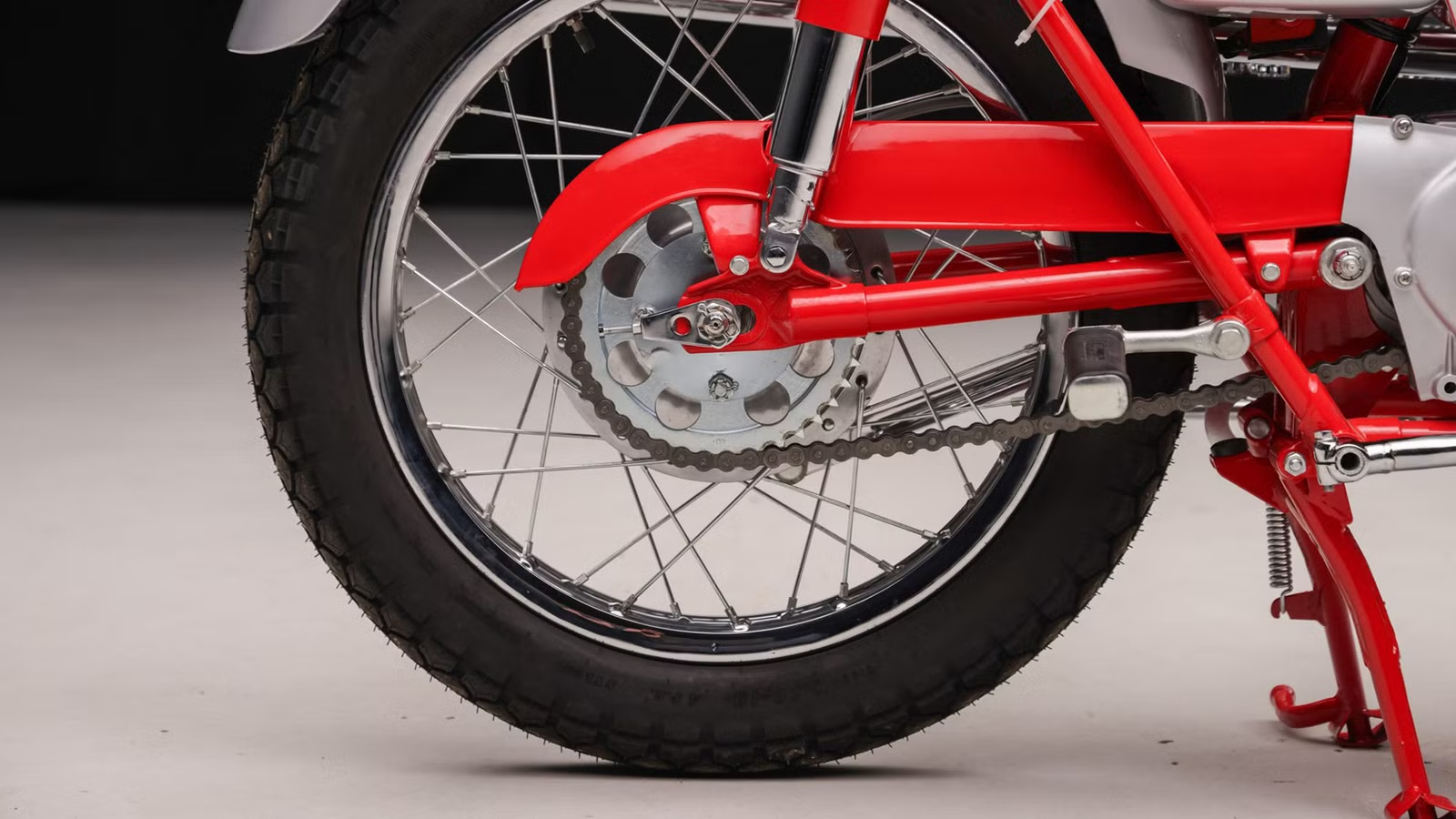
The Triumph Scrambler 1200 offers a great combination of street credit as well as design and functionality for some basic off-road riding. The same could be said of Ducati’s Desert Sled as well as the Royal Enfield Scram 411.

All of these look the part and will happily cruise along a gravel road all day long. However, while they might be some of the most modern motorcycles from each respective brand in the second decade of the 21st century, their roots can all be traced back to a motorcycle from as early as 1962…and that motorcycle was Japanese.
Honda Built The CL72 Specifically For American Riders
As early as 1959, Honda began to import the Super Cub from Japan into North America. At this time, Honda in America identified a demand in the region for motorcycles that could be ridden both on-road and on dirt roads and trails. The company also paid close attention to the American lifestyle.

This was a clever move by the company, rather than simply importing the products they manufactured in Japan. The result was that new models were specifically created for American customers. What followed was a motorcycle like the CL72 and, a few years later, the CL77.
Every Styling Cue Started With Function, Not Fashion

Unlike today, where some design details are added to please the eye, this was not the case with one of the earliest scramblers. To keep things simple, reduce the weight and keep the price as low as possible, both the CL72 and CL77 were kick-start-only models. They also offered high-mounted exhaust pipes, cross-braced handlebars for strength, a skid plate in front of the engine for protection, and large 19-inch wheels for better handling and grip.
There was no agenda to make this a fashionable motorcycle, only to offer a practical and usable motorcycle that would appeal to buyers who would use it as the Japanese engineers intended.
A Lightweight Twin That Embarrassed Bigger British Bikes

The CL72 was introduced in 1962 and was referred to in Honda’s own marketing material as a scrambler for “track and field.” Honda bragged about the 80 mph top speed and a quarter-mile time of 17 seconds.
The 4-stroke, parallel-twin engine had a capacity of 247cc and produced 25 hp at 9,200 rpm. Curb weight was 315 lbs, and the list price was $690. Produced for three years, the CL72 was replaced by the larger CL77, which was also produced for three years.
Engine size, shared with the CB77 Super Hawk, increased to 305cc, and power went up to 27.4 hp. Competitors at the time included the Triumph TR6C Trophy with its 649cc parallel-twin engine and the Norton P11 with its 745cc parallel-twin engine. Although these motorcycles produced more power, they were heavier than the Hondas, which weighed 315 lbs for the CL72 and 337 lbs for the CL77.
The Baja Run That Changed Honda’s Reputation Forever

In 1962, it was two sales managers at American Honda Motor Company who came up with a plan to put their new CL72 scramblers firmly on the map for riding enthusiasts. Dave Ekins and Bill Robertson Jr. set out to ride the length of Baja.
Using these two brand-new Hondas, the pair set out on this adventure.
After 39 hours and 56 minutes, Ekins arrived in La Paz after having covered 952.7 miles! Ninety minutes later, Robertson arrived. Needless to say, the newcomer to the American motorcycle industry had proven itself, and riders immediately took notice. This was just the start of Honda’s success, though.
The CL77 Backed Up The Hype With A Baja 1000 Victory
Although the initial ride by Ekins and Robertson laid the foundation, it was the 1968 Mexican 1000 victory (later changed to the Baja 1000) that cemented Honda’s combination of proven reliability and durability. Larry Bergquist and Gary Preston rode a CL77 on the 832-mile Ensenada-to-La Paz course and were victorious in a very impressive time of 20 hours and 38 minutes. Let’s put that into perspective.
The year before, riders J.N. Roberts and Malcolm Smith did the race on a Husqvarna 360 Cross in 28 hours and 48 minutes. The Honda riders took a nearly unbelievable eight hours off the previous year’s winning time. Now, more than ever before, the ability of the Honda CL77, and Honda’s motorcycles in general, was proven for everyone to see.
It Was Surprisingly Affordable And Americans Bought Thousands

The launch prices for these two scramblers were $690 in 1962 for the CL72, followed by $720 for the CL77 in late 1965. This sales success is partly attributed to the fact that British motorcycles at the time were significantly more expensive, at over $1,000. This further drew attention to this capable Japanese lightweight.
The victories and the publicity that came from them did lure thousands of buyers to hand over cash for these Japanese marvels. Honda also worked with a plan even before these successes, though. In the early years, they approached motorcycle shops and offered their Honda products. Very quickly, they built up a dealership network with incentives. As early as 1961, successful dealers were invited to Japan.
Triumph, Ducati, And Royal Enfield Are Still Following Its Blueprint

Look at modern, retro scramblers, and it is possible to draw a continuous thread from the Honda CL models all the way to some of today’s examples. The Triumph Scrambler 1200 offers a near-identical silhouette of the CL models. It also offers the notable upswept exhaust pipes and skid plate. The same can be said of Ducati’s Desert Sled, which is also a street scrambler, offering a skid plate and high fenders.
Although none of these modern motorcycles are earmarked for challenging off-road courses, fitted with knobby tires, they will still be able to conquer some gravel roads. Whereas today’s riders usually only ride them on pavement, it is the original CL models that put these motorcycles on the map as dual-use bikes for pavement and off-road riding.
Honda’s Forgotten Scrambler Quietly Changed Motorcycle Design Forever

Owing to Honda’s approach of offering lighter, more affordable, and easier-to-own motorcycles, it is surprising these motorcycles do not receive even more recognition. Manufacturers other than Honda are unlikely to admit what an important role the CL72 and CL77 played in the early scrambler and dual-sport motorcycle industry. But with those long-distance successes in both 1962 and 1968, Honda firmly entered this market segment.
An estimated 90,000 units were bought by Americans during this time, making them some of the most loved motorcycles from the 1960s. Consider that, plus the fact that the overall design six decades later is now being sold back to us as heritage models, and one can start to see the impact these CL models have had on the industry.
Source: Cycle World, Honda, Hagerty

Related posts

Latest Post


No Comments