
The McLaren 788HS Wears A Badge Only Three Cars Have Ever Earned
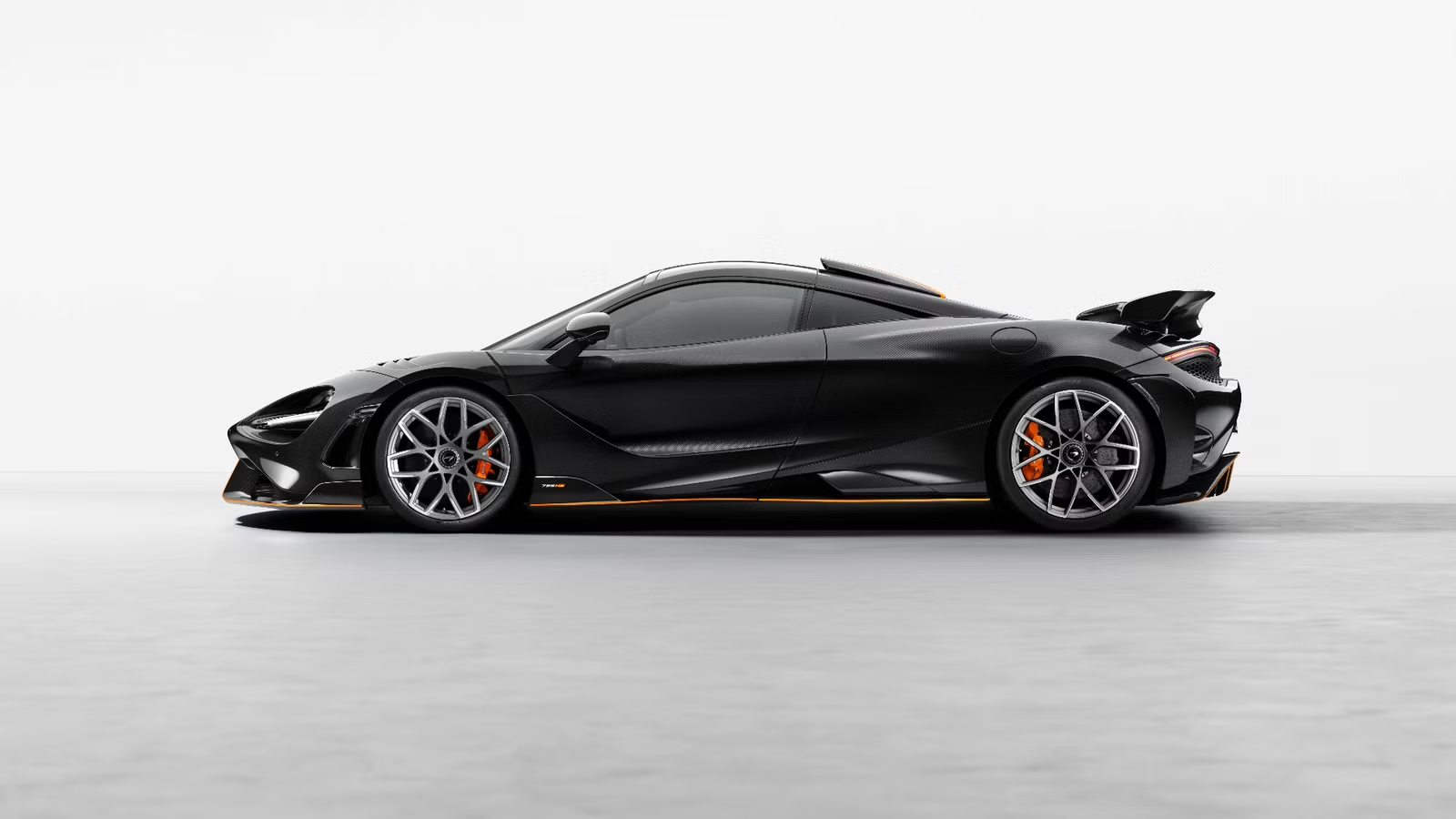
McLaren has drawn the curtain on one of the most celebrated supercar lineages of the modern era. The 788HS — announced today — is the definitive final evolution of the 720S, 750S, and 765LT family, limited to just 200 units worldwide and built to close that chapter at its absolute peak.

At the center of it is a 788 horsepower version of the M840T 4.0-litre twin-turbo V8, and because it tips the scales at 2,788 lbs dry weight it has a power-to-weight ratio of 623 hp per tonne — the highest any car in this series has ever achieved. Only two McLarens have ever worn the ‘HS’ — High Sport — designation before it: the MP4-12C HS and the MSO HS. The 788HS is the third. That badge doesn’t get handed out lightly.
A Farewell Built Around The HS Badge’s Rare Legacy

The ‘High Sport’ designation exists at the very top of McLaren’s series production hierarchy, reserved for expressions that go beyond a trim upgrade or a power bump. It signals a holistic rethink — and the 788HS earns it across every system. Henrik Wilhelmsmeyer, McLaren’s Chief Commercial Officer, described the car as engineered with “a singular focus” to deliver a visceral, captivating drive through “precise balance of performance, sound, dynamism and individuality.”

Production splits evenly between coupe and spider variants — 100 of each — and every example is personalized through McLaren Special Operations. Clients can specify full Visual Carbon Fibre bodywork across every exterior panel, in gloss or satin finish, turning each car into something genuinely individual. A bespoke HS perforation pattern runs through the upholstery, and a dedication plaque sits inside the cabin. These aren’t optional flourishes; they’re part of what makes each 788HS its own artifact.
F1-Inspired Aero And Senna-Derived Brakes Sharpen The Platform

The aerodynamic package on the 788HS is the most advanced ever fitted to this platform, and it starts with a new S-Duct bonnet — the same principle that feeds clean air through the nose of a Formula 1 car. Combined with a multi-zone front splitter, a raised active rear spoiler, a louvred under-wing panel, and a racing-inspired rear diffuser, the result is a 10% increase in downforce over the 765LT, with McLaren claiming no compromise to vehicle balance or dynamics.
Stopping power gets an equally serious upgrade. The carbon ceramic brake discs are derived directly from the McLaren Senna, paired with six-piston forged aluminium monoblock front calipers and integrated cooling ducts designed for sustained high-performance use. The 788HS also introduces the first centre-lock wheel mechanism ever fitted to this supercar series, mounted to a new Super Lightweight Forged Alloy design. Front ride height drops 5mm versus the 750S, and the Proactive Chassis Control III linked-hydraulic suspension runs bespoke tuning developed specifically for this car.
The V8 Gets A Voice To Match Its Numbers

The M840T revs to 8,500rpm and peaks at 7,500rpm, delivering 800Nm of torque at 5,500rpm. The sprint figures are what you’d expect from 623PS per tonne: 0–100km/h in 2.8 seconds, 0–200km/h in 7.0 seconds flat, and a 330km/h (205mph) top speed. What the numbers don’t capture is what McLaren has done to the engine’s character.
A unique engine mount calibration sharpens the mechanical connection between powertrain and driver — McLaren says it heightens engagement without sacrificing long-distance usability, which matters for a car that’s as likely to see a road trip as a track day. The quad-exit titanium exhaust amplifies the V8’s soundtrack with more intensity through the rev range, while revised induction and exhaust sound symposer technologies work together to put the twin-turbo’s voice front and center in the cabin. For a forced-induction engine, the 788HS sounds like it has something to say.
For the McLaren faithful who’ve followed this lineage from the 720S forward, the 788HS is exactly what a send-off should be — not a softened tribute, but the hardest, sharpest version of something they already loved. Here’s hoping future McLaren series get a finale this well-considered.

Related posts



Latest Post



No Comments