
Ford Just Fired Up Its New 5.4-Liter Coyote V8 — And You Need To Listen To It Roar
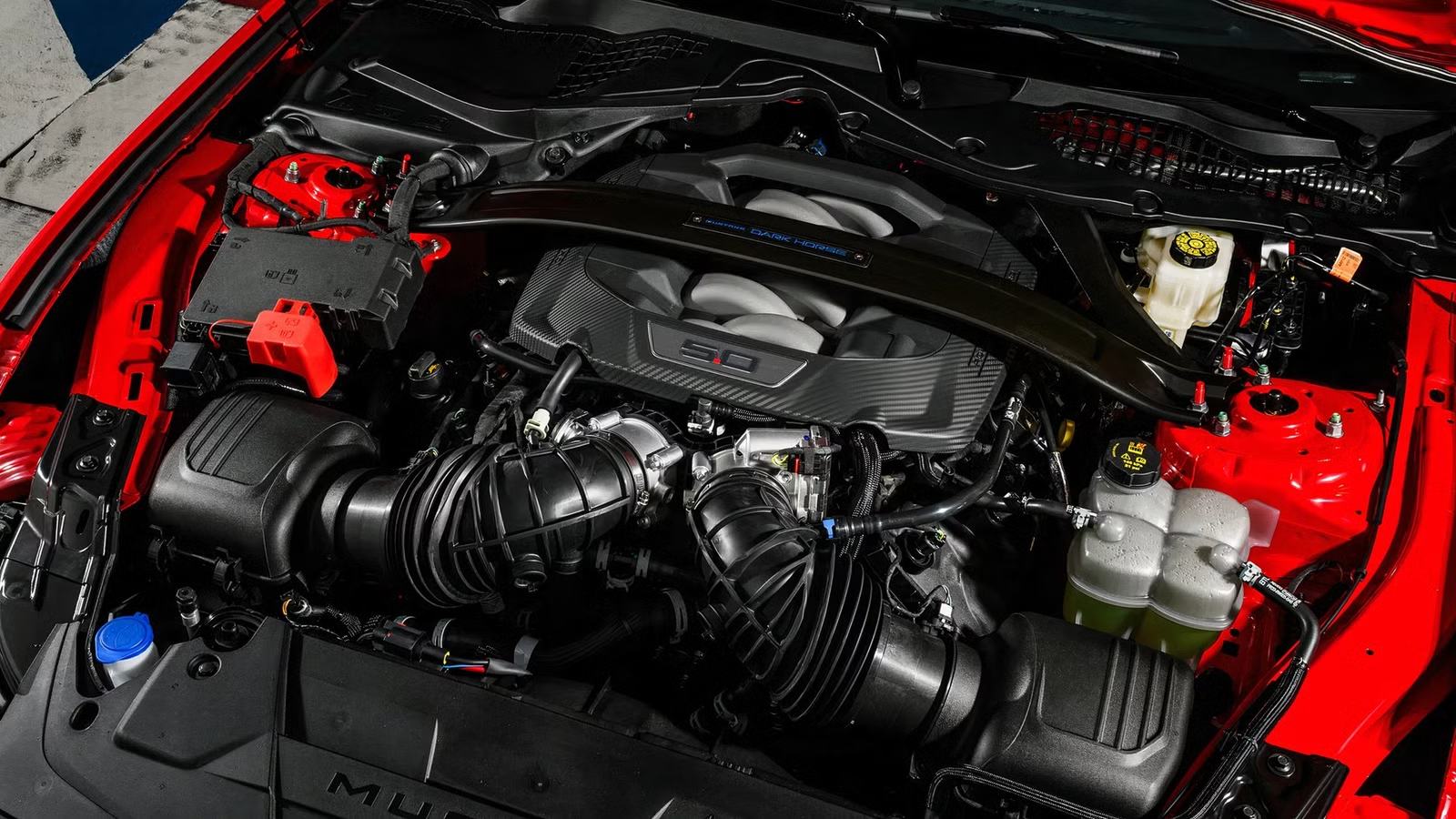
Ford’s 2027 WEC Hypercar campaign got its most visceral proof of life this week when engineers fired up the new 5.4-liter Coyote V8 for the first time. The sound that came out of that dyno cell is exactly what endurance-racing fans have been waiting to hear — a hard, high-revving V8 bark that signals Ford isn’t just showing up at Le Mans, it’s showing up ready to fight.

The first fire-up is more than a milestone on a Gantt chart. It’s the moment a racing program stops being renderings and press releases and becomes something real. Ford’s new factory race engine is real, it’s running, and the displacement choice alone tells you something deliberate is happening inside Dearborn’s motorsport engineering group.
The Sound Is the Story — And It Tells You Everything About This Engine’s Character
A WEC Hypercar engine note isn’t incidental. It’s a fingerprint. The 5.4-liter Coyote V8’s first fire-up audio reveals a naturally aspirated character — the kind of free-breathing, high-revving exhaust note that turbocharged units simply cannot replicate. Where a boosted engine builds sound as boost pressure climbs, a big-displacement NA V8 hits immediately, with a rawness that carries across a pit lane and into the grandstands at La Sarthe.
For Ford, that sound is also a statement of intent. The Coyote lineage traces back to the 5.0-liter V8 that revived the Mustang GT’s credibility in 2011, and the architecture has been developed continuously since. Stepping up to 5.4 liters for the hypercar application suggests the engineering team wanted more low-end torque authority and a broader power band — both useful qualities across 24 hours of racing where the hybrid system’s deployment window matters as much as peak output.
Why 5.4 Liters — Displacement Strategy Inside WEC Hypercar Rules

WEC Hypercar regulations cap total system power at 500 kW (roughly 671 hp) and require a hybrid component on the front axle, with the combustion engine driving the rear. Within those constraints, manufacturers have latitude on displacement and configuration — and Ford’s choice of 5.4 liters is a deliberate one.
A larger-displacement naturally aspirated engine can produce its power at lower peak rpm compared to a smaller, highly stressed unit, which has durability implications across a 24-hour race. It also means the combustion engine can run in a more favorable efficiency window while the hybrid system handles peak demand moments — acceleration out of the Ford Chicanes, for instance, or the blast down Mulsanne. The 5.4-liter figure positions the Coyote V8 as a torque-forward, endurance-optimized unit rather than a screaming short-stroke sprint engine. Confirmed power figures for the combustion side specifically have not been released yet; Ford has not published a standalone output number for the V8 at this stage of development.
Ford’s Hypercar Field Is Taking Shape — And the Competition Is Watching

The engine fire-up lands in a WEC Hypercar landscape that is getting crowded fast. McLaren has already unveiled its MCL-HY for 2027, a program that reportedly targets close to 700 hp at the system level. Toyota continues to develop its hydrogen-combustion hypercar alongside its conventional GR010 successor. Porsche is hinting at a 2030-era program. Ferrari and Cadillac are already racing.
Ford’s driver lineup for 2027 is also locked in, with IMSA-proven talent confirmed alongside reported discussions with higher-profile names. The program has the structure of a serious factory effort — not a one-car experiment. Firing the engine this week, with the 2027 season still months away, suggests the development schedule is on track and Ford has the runway to accumulate meaningful test miles before the car has to qualify at Le Mans.
Ford and Le Mans — Why This Return Carries Weight

The GT40’s four consecutive Le Mans victories from 1966 to 1969 are the foundation of Ford’s endurance-racing identity. The GT program that ran from 2016 to 2019 — culminating in a class win on the 50th anniversary of the original GT40 triumph — proved the factory still knew how to build a race car that could survive 24 hours and beat the best in the world.
The 2027 WEC Hypercar entry is a different challenge. The Hypercar class runs against Ferrari, Toyota, Porsche, and now McLaren at a level of factory investment that makes the GT class look like a warm-up act. Ford isn’t entering to fill a grid slot. The 5.4-liter Coyote V8 firing up this week is the clearest signal yet that the Blue Oval is building something capable of genuinely contending — and gearheads who’ve been waiting for Ford to come back to the top class of endurance racing have every reason to be paying attention right now.

Related posts



Latest Post


No Comments