
Fiat Is Finally Bringing The Topolino To America—Here’s What The Tiny EV Actually Is

The Topolino name carries serious weight in automotive history—it belonged to the original Fiat 500 of the late 1930s, a car so small and so beloved that Italians nicknamed it “little mouse.” Now, nearly 90 years later, Fiat is bringing that name back on a modern electric microcar, and this summer it’s finally headed to the United States.

Fiat confirmed the U.S. arrival of the Topolino EV this week alongside the reveal of the Multiplina concept, framing both as part of a broader micromobility push. The Topolino is already on sale in Europe, where it has found a niche as an ultra-compact urban runabout. The American launch raises an obvious question that Fiat’s press materials don’t fully answer: can you actually drive one on public roads where you live?
What the Topolino Actually Is—And What It Isn’t
The Topolino is not a conventional car. It’s a quadricycle—a vehicle category defined by strict limits on weight, power, and top speed that sits below the passenger-car threshold in European regulation. The current Topolino is a two-seat open-air electric vehicle with a roughly 5.4 kWh battery, a range of around 46 miles, and a top speed capped at approximately 28 mph. Power output sits at about 8 horsepower, which sounds modest until you remember that it weighs under 1,100 pounds and was never designed for highway use.


Dimensions are genuinely tiny—the Topolino measures roughly 98 inches long, which is shorter than a Smart ForTwo. It comes in both a closed “Dolcevita” body style and an open “Targa”-style version. Pricing in Europe has started around €10,000, though Fiat has not yet confirmed U.S. pricing. Given import costs and any regulatory compliance work, expect that number to climb for American buyers.
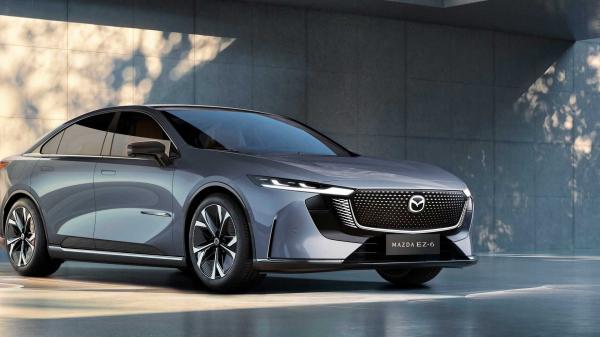
Mazda Launches New Sporty Electric Sedan For A Shockingly Low Price
With a $22,000 sticker, the Mazda 6e could take a tariff hit and still be cheaper than a used Tesla Model 3.
The Regulatory Maze: Quadricycles and U.S. Law

Here’s where things get complicated. The quadricycle category that makes the Topolino legal and practical across much of Europe does not exist as a federal vehicle classification in the United States. The closest domestic analog is the Low-Speed Vehicle (LSV) category, which the NHTSA defines as a four-wheeled motor vehicle with a top speed between 20 and 25 mph. LSVs are street-legal in most states on roads posted at 35 mph or under, and they require basic safety equipment—headlights, turn signals, mirrors, seat belts, and a VIN.
The Topolino’s 28 mph top speed puts it right at the edge of that LSV window, and its two-seat open configuration adds further complexity. Whether it qualifies as an LSV in a given state depends on how that state interprets the federal baseline. Some states have adopted the federal LSV standard directly; others have additional restrictions or don’t recognize the category at all for public-road use. A handful of states limit LSVs to specific planned communities or private roads entirely.

For buyers, this means the answer to “can I drive it?” is genuinely location-dependent. Someone in a Sun Belt retirement community or a dense urban area with low-speed corridors may find the Topolino perfectly usable. A buyer in a rural state where the nearest grocery store requires 55 mph highway access will likely find it impractical as a primary vehicle—or possibly unregisterable for public roads at all. Fiat has not yet detailed what compliance path the U.S.-bound Topolino will follow, which is the single most important piece of information prospective buyers are still waiting on.
A Nameplate With Real History Behind It

Calling the new Topolino a nameplate revival isn’t marketing spin—it’s accurate. The original Fiat 500 Topolino debuted in 1936 as one of the most affordable cars in Europe, designed explicitly to put working-class Italians behind the wheel. It displaced just 569cc, made around 13 horsepower, and became a cultural touchstone across the continent. Production ran until 1955, by which point over 500,000 had been built.
The decision to resurrect the name on an electric quadricycle rather than a full-size car is deliberate. Fiat is positioning the Topolino as the spiritual heir to that original accessibility mission—a vehicle for urban mobility rather than open-road driving. Whether that framing resonates with American buyers, who have very different infrastructure expectations than European city dwellers, remains to be seen.
The Multiplina Concept and What Comes Next

Alongside the Topolino U.S. news, Fiat also pulled the wraps off the Multipla concept—described by the company as the missing link between the Topolino and a proper subcompact. The Multiplina is roughly the size of the original Fiat 500, positioning it as a slightly more conventional small EV that could theoretically meet full passenger-car safety standards. It remains a concept for now, with no production timeline confirmed.
For U.S. buyers, the Multiplina is the more intriguing long-term prospect—a Fiat small EV that could actually be registered and driven anywhere in the country without navigating quadricycle gray areas. But that’s a future conversation. For now, the Topolino is what’s arriving this summer, and understanding exactly what it is—and where you can legally use it—is the homework worth doing before getting excited about the price tag.

Related posts





Latest Post


No Comments